 …
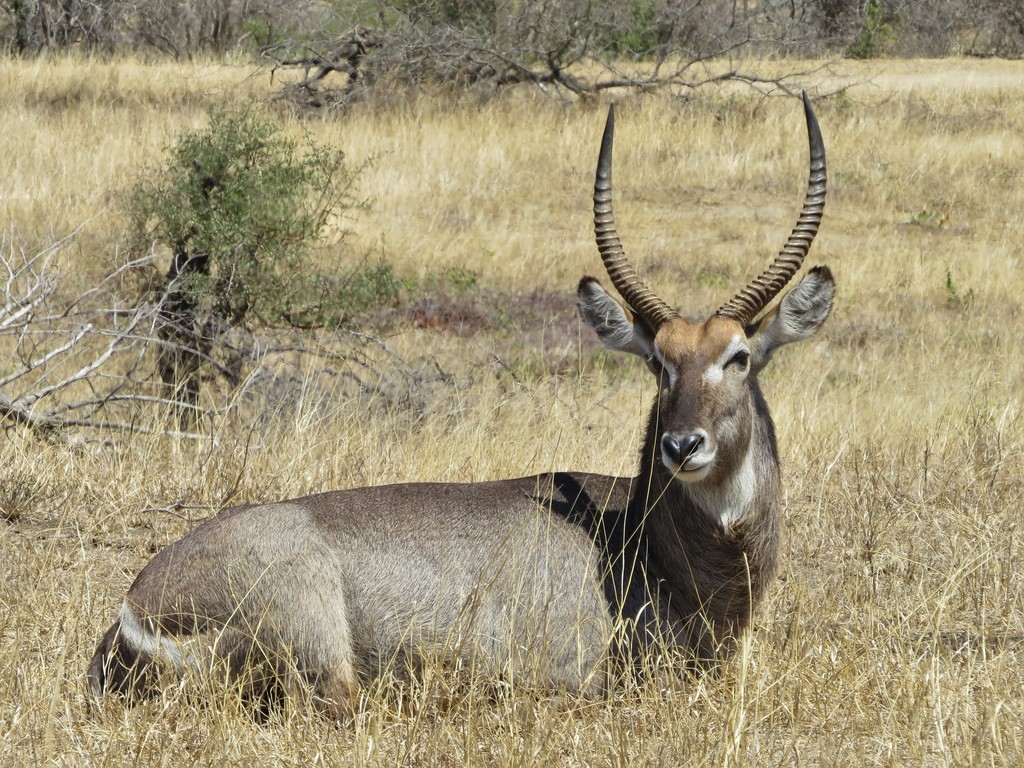
Waterbuck
Kobus ellipsiprymnus
Mammalstrong against birds, fungi
Common
Pack
While active with another mammal in play, it hits 7 harder (14 with two others).
42

29
Waterbuck
Kobus ellipsiprymnus
Mammalstrong against birds, fungi
Common
While active with another mammal in play, it hits 7 harder (14 with two others).
Kobus ellipsiprymnus
Photo: © Rafael Tosi (original photo) · CC BY 4.0 (licence text) · cropped
Strong against: it deals 20% more damage to them. Weak against: these types deal 20% more damage to it.
The waterbuck (Kobus ellipsiprymnus) is a large antelope found widely in sub-Saharan Africa. It is in the genus Kobus of the family Bovidae. It was first described by Irish naturalist William Ogilby in 1833. Its 13 subspecies are grouped under two varieties: the common or ellipsiprymnus waterbuck and the defassa waterbuck. Their coat colour varies from brown to grey. The long, spiral horns, present only on males, curve backward, then forward, and are 55–99 cm (22–39 in) long.
Waterbucks are rather sedentary in nature. As gregarious animals, they may form herds consisting of six to thirty individuals. These groups are either nursery herds with females and their offspring or bachelor herds. Males start showing territorial behaviour from the age of five years, but are most dominant from six to nine. The waterbuck cannot tolerate dehydration in hot weather, and thus inhabits areas close to sources of water. Predominantly a grazer, the waterbuck is mostly found on grassland. In equatorial regions, breeding takes place throughout the year, but births are at their peak in the rainy season. The gestational period lasts 7–8 months, followed by the birth of a single calf.
Abridged excerpt from the Wikipedia article Waterbuck, by its authors, under the CC BY-SA 4.0 licence.
Least Concern on the IUCN Red List: that’s what makes this card Common.
Every Common card has 100 points, shared between HP, ATK and DEF:
How they’re shared out:

 DEF 29