 …
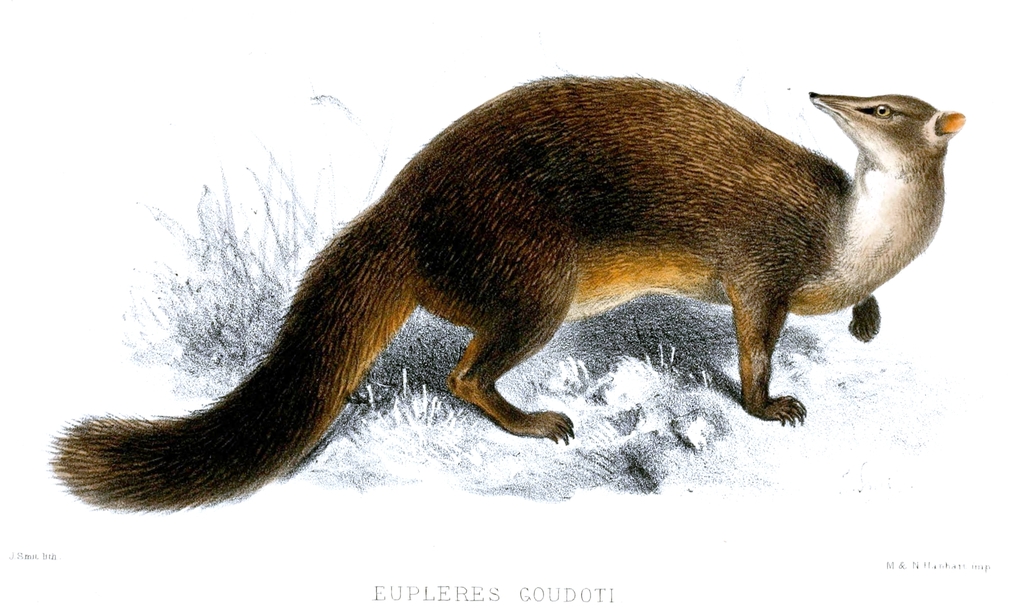
Falanouc
Eupleres goudotii
Mammalstrong against birds, fungi
Rare
Pack
While active with another mammal in play, it hits 7 harder (14 with two others).
39

43
Falanouc
Eupleres goudotii
Mammalstrong against birds, fungi
Rare
While active with another mammal in play, it hits 7 harder (14 with two others).
Eupleres goudotii
Photo: Joseph Smit (original photo) · public domain (licence text) · cropped
Strong against: it deals 20% more damage to them. Weak against: these types deal 20% more damage to it.
The eastern falanouc (Eupleres goudotii) is a rare mongoose-like mammal in the carnivoran family Eupleridae endemic to Madagascar.
Until 2010, both falanoucs were classified as the same species, Eupleres goudotii, which was the only species in the genus Eupleres. Then the falanouc was split into two species, eastern falanouc (Eupleres goudotii) and western falanouc (Eupleres major). Falanoucs have several peculiarities. They have no anal or perineal glands (unlike their closest relative, the fanaloka), nonretractile claws, and a unique dentition: the canines and premolars are backwards-curving and flat. This is thought to be related to their prey, mostly invertebrates, such as worms, slugs, snails, and larvae.
It lives primarily in the lowland rainforests of eastern Madagascar, while E. major is found in northwest Madagascar. It is solitary and territorial, but whether nocturnal or diurnal is unknown. It is small (about 50 centimetres long with a 24-centimetre-long tail) and shy (clawing, not biting, in self-defence). It most closely resembles the mongooses with its long snout and low body, though its colouration is plain and brown (most mongooses have colouring schemes such as striping, banding, or other variations on the hands and feet).
Abridged excerpt from the Wikipedia article Eastern falanouc, by its authors, under the CC BY-SA 4.0 licence.
Vulnerable on the IUCN Red List: that’s what makes this card Rare.
Every Rare card has 130 points, shared between HP, ATK and DEF:
How they’re shared out:

 DEF 43