 …
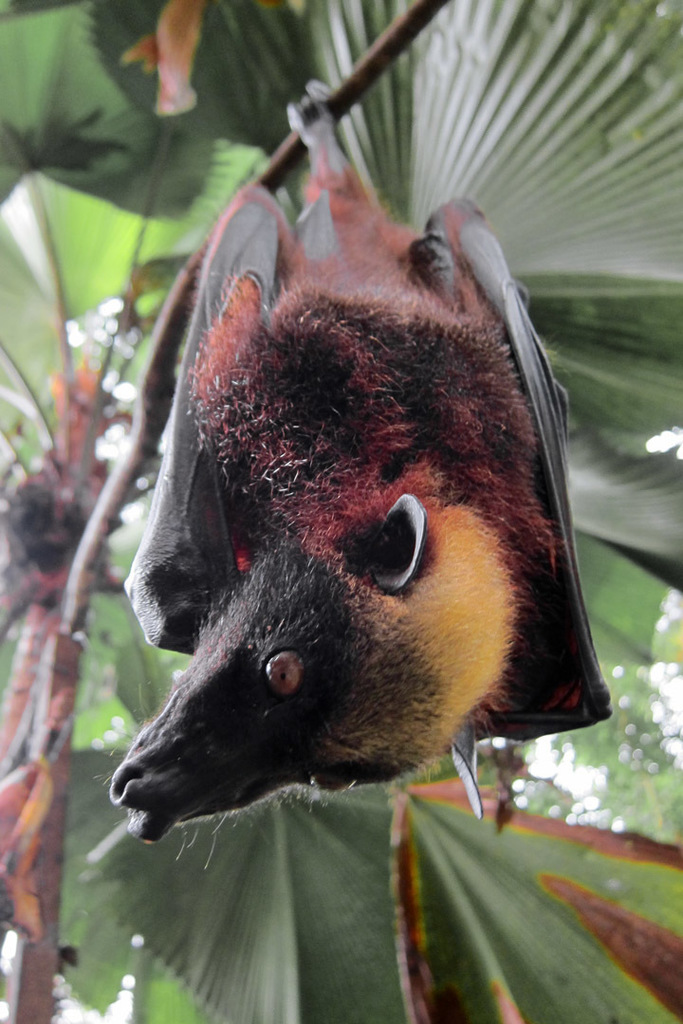
Golden-capped Fruit Bat
Acerodon jubatus
Mammalstrong against birds, fungi
Epic
Pack
While active with another mammal in play, it hits 7 harder (14 with two others).
57

52
Golden-capped Fruit Bat
Acerodon jubatus
Mammalstrong against birds, fungi
Epic
While active with another mammal in play, it hits 7 harder (14 with two others).
Acerodon jubatus
Photo: © Gregg Yan (original photo) · CC BY-SA 4.0 (licence text) · cropped
Strong against: it deals 20% more damage to them. Weak against: these types deal 20% more damage to it.
The giant golden-crowned flying fox (Acerodon jubatus), also known as the golden-capped fruit bat, is a species of megabat endemic to the Philippines. Since its description in 1831, three subspecies of the giant golden-crowned flying fox have been recognized, one of which is extinct. The extinct subspecies (A. jubatus lucifer) was formerly recognized as a full species, the Panay golden-crowned flying fox. Formerly, this species was placed in the genus Pteropus; while it is no longer within the genus, it has many physical similarities to Pteropus megabats. It is one of the largest bat species in the world, weighing up to 1.4 kg (3.1 lb)—only the Indian and great flying fox can weigh more. It has the longest documented forearm length of any bat species at 21 cm (8.3 in).
It is primarily frugivorous, consuming several kinds of fig and some leaves. It forages at night and sleeps during the day in tree roosts. These roosts can consist of thousands of individuals, often including another species, the large flying fox. Not much is known about its reproduction; it gives birth annually from April through June, with females having one pup at a time. Predators of the giant golden-crowned flying fox include raptors such as eagles, the reticulated python, and humans.
Abridged excerpt from the Wikipedia article Giant golden-crowned flying fox, by its authors, under the CC BY-SA 4.0 licence.
Endangered on the IUCN Red List: that’s what makes this card Epic.
Every Epic card has 145 points, shared between HP, ATK and DEF:
How they’re shared out:

 DEF 52