 …
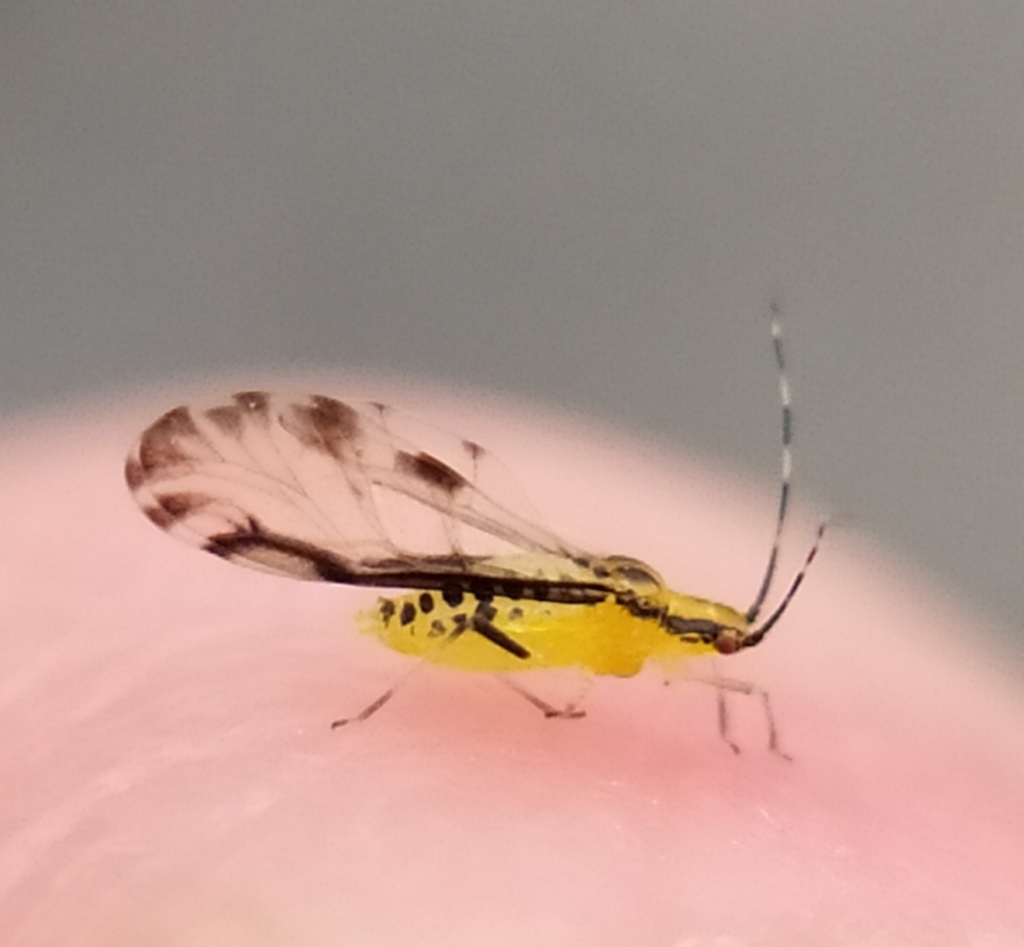
Lime Leaf Aphid
Eucallipterus tiliae
Insectstrong against fungi, fish
Common
Swarm
While active with another insect in play, each of its attacks also hits the opposing bench for 10, without knocking them out (20 with two others).
38

39
Lime Leaf Aphid
Eucallipterus tiliae
Insectstrong against fungi, fish
Common
While active with another insect in play, each of its attacks also hits the opposing bench for 10, without knocking them out (20 with two others).
Eucallipterus tiliae
Photo: © carnifex (original photo) · CC BY 4.0 (licence text) · cropped
Strong against: it deals 20% more damage to them. Weak against: these types deal 20% more damage to it.
Eucallipterus tiliae, also known as the linden aphid or lime-tree aphid, is a member of the family Aphididae. Native to Eurasia in recent times, it is now found worldwide wherever species of Tilia occur.
Adults are readily identified by a black stripe along the body and a cloudy-black wing edge. Ornamental trees along streets and parking areas are often populated by these insects, leaving a sticky residue (honeydew) on the ground below and causing a black mould to grow on the leaves. Numbers increase continuously over the growing season of the host plant, and because of the gregarious nature of these insects large aggregations are common. Ten species of Ichneumonoidea, nine of Chalcidoidea, various Coccinellidae, and Trioxys curvicaudus are recorded as parasitoids on Eucallipterus.
The distribution of young and mature aphids on the leaf surfaces is dictated by their stylet length - the short stylets of young aphids cannot penetrate the lignin of the sclerenchyma of large veins and are thus restricted to feeding on smaller veins.
Abridged excerpt from the Wikipedia article Eucallipterus tiliae, by its authors, under the CC BY-SA 4.0 licence.
No global status on the IUCN Red List: that’s what makes this card Common.
Every Common card has 100 points, shared between HP, ATK and DEF:
How they’re shared out:

 DEF 39