 …
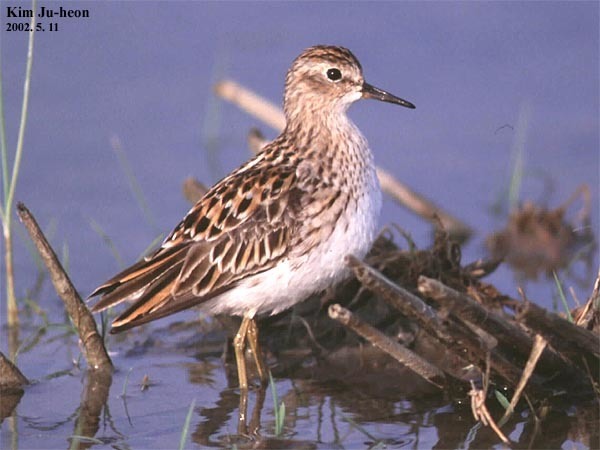
Long-toed Stint
Calidris subminuta
Birdstrong against fish, reptiles
Common
Swoop
While active with another bird in play, it hits 6 harder on its first attack after entering play (12 with two others).
30

40
Long-toed Stint
Calidris subminuta
Birdstrong against fish, reptiles
Common
While active with another bird in play, it hits 6 harder on its first attack after entering play (12 with two others).
Calidris subminuta
Photo: © Kim, Hyun-tae (original photo) · CC BY 4.0 (licence text) · cropped
Strong against: it deals 20% more damage to them. Weak against: these types deal 20% more damage to it.
The long-toed stint (Calidris subminuta) is a small wader. The genus name is from Ancient Greek kalidris or skalidris, a term used by Aristotle for some grey-coloured waterside birds. The specific subminuta is from Latin sub, "near to" and minuta, "small" from its similarity to the little stint, Calidris minuta.
Within the genus Calidris the long-toed stint is most closely related to Temminck's stint (Calidris temminckii).
It breeds across northern Asia and is strongly migratory, wintering in south and south east Asia and Australasia. It occurs in western Europe only as a very rare vagrant.
This bird has yellowish legs and a short thin dark bill. Breeding adults are a rich brown with darker feather centres above and white underneath. They have a light line above the eye and a brown crown. In winter, long-toed stints are grey above. The juveniles are brightly patterned above with rufous colouration and white mantle stripes.
This bird can be difficult to distinguish from other similar tiny waders which are known collectively as "peeps" or "stints". In particular, the long-toed stint is very similar to its North American counterpart, the least sandpiper. It differs from that species in its more slender, longer-necked appearance, longer toes, somewhat brighter colours, and weaker wingbar.
Abridged excerpt from the Wikipedia article Long-toed stint, by its authors, under the CC BY-SA 4.0 licence.
Least Concern on the IUCN Red List: that’s what makes this card Common.
Every Common card has 100 points, shared between HP, ATK and DEF:
How they’re shared out:

 DEF 40