 …
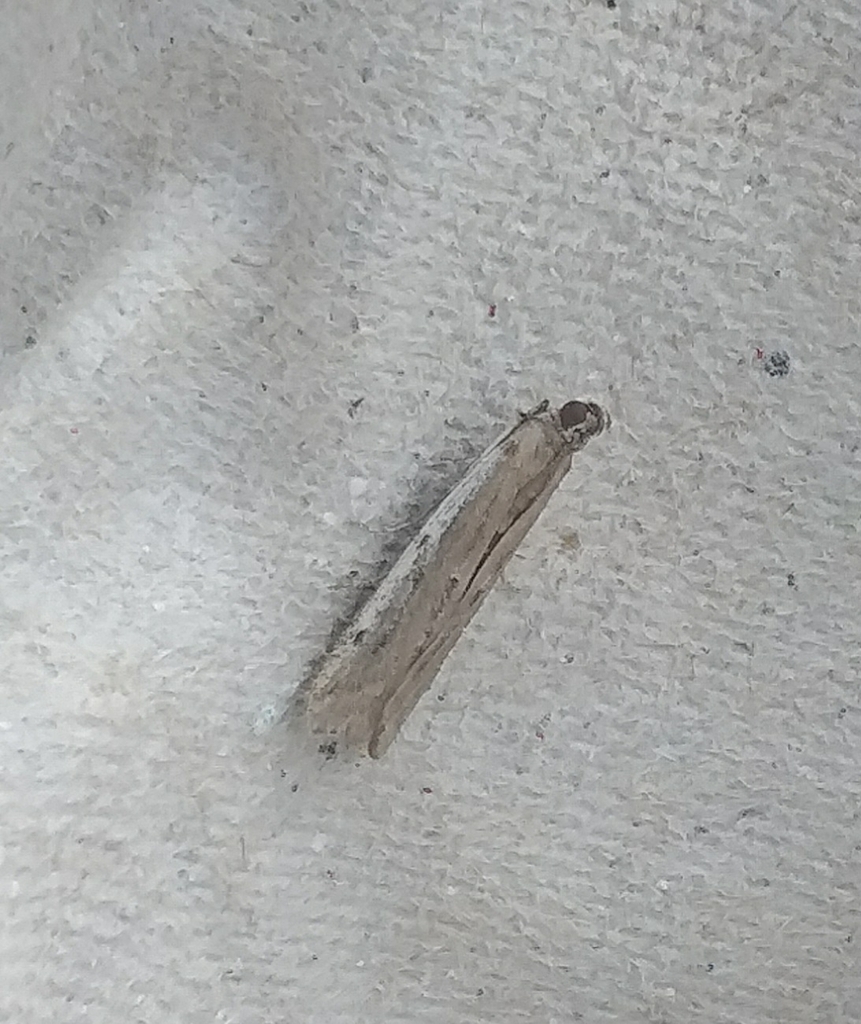
Ermine Knot-horn
Phycitodes binaevella
Insectstrong against fungi, fish
Common
Swarm
While active with another insect in play, each of its attacks also hits the opposing bench for 10, without knocking them out (20 with two others).
39

39
Ermine Knot-horn
Phycitodes binaevella
Insectstrong against fungi, fish
Common
While active with another insect in play, each of its attacks also hits the opposing bench for 10, without knocking them out (20 with two others).
Phycitodes binaevella
Photo: © Jacqueline Worthington (original photo) · CC BY 4.0 (licence text) · cropped
Strong against: it deals 20% more damage to them. Weak against: these types deal 20% more damage to it.
Phycitodes binaevella is a species of snout moth described by Jacob Hübner in 1813. It is found in most of Europe (except Portugal), Asia Minor, Lebanon and the Palestinian Territories.
The wingspan is 18–27 millimetres (0.71–1.06 in). The forewings are distinctly dilated, pale brownish-ochreous, costal half suffused with white, with a few dark fuscous scales; first line indicated by a straight oblique series of three large dark fuscous dots; second pale, obscurely dark-edged; two large dark fuscous transversely placed discal dots. The hindwings arenlight fuscous. The larva is pale green; dorsal and subdorsal lines pink; spiracular pink, interrupted; head reddish-brown; plate of 2 posteriorly brownish: in flower-heads of.Cardwus lanceolatus.
There is one generation with adults on wing from July to August.
The larvae feed on Cirsium vulgare, Carduus, Aster, Tanacetum vulgare and Artemisia vulgaris.
Excerpt from the Wikipedia article Phycitodes binaevella, by its authors, under the CC BY-SA 4.0 licence.
No global status on the IUCN Red List: that’s what makes this card Common.
Every Common card has 100 points, shared between HP, ATK and DEF:
How they’re shared out:

 DEF 39