 …
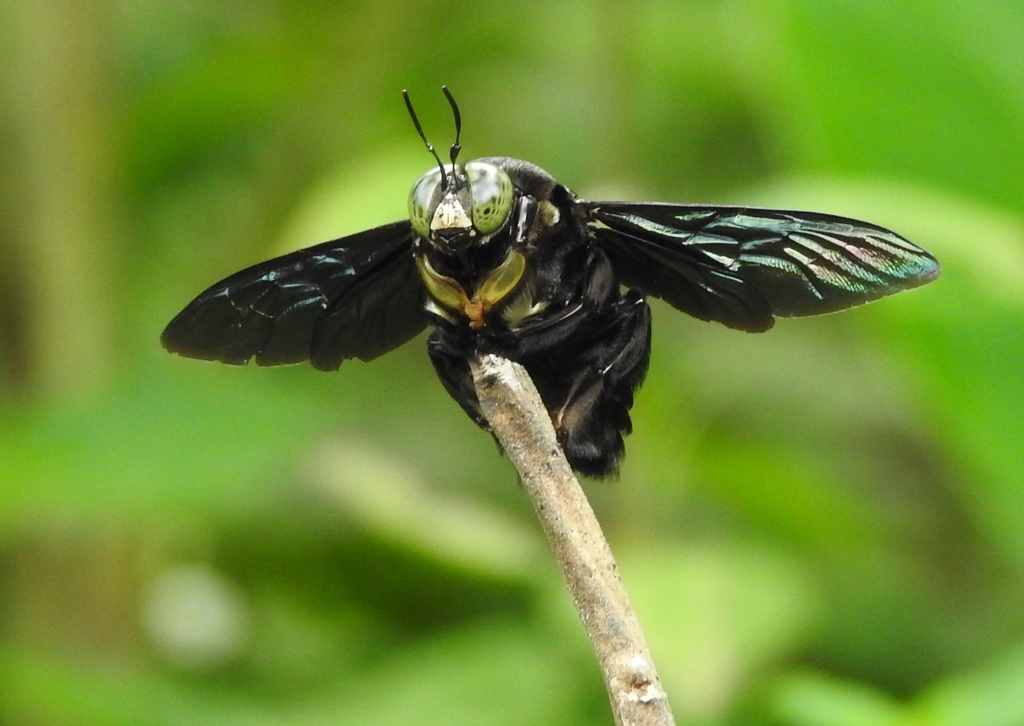
Broad-handed Carpenter Bee
Xylocopa latipes
Insectstrong against fungi, fish
Common
Swarm
While active with another insect in play, each of its attacks also hits the opposing bench for 10, without knocking them out (20 with two others).
31

39
Broad-handed Carpenter Bee
Xylocopa latipes
Insectstrong against fungi, fish
Common
While active with another insect in play, each of its attacks also hits the opposing bench for 10, without knocking them out (20 with two others).
Xylocopa latipes
Photo: © anukma (original photo) · CC BY 4.0 (licence text) · cropped
Strong against: it deals 20% more damage to them. Weak against: these types deal 20% more damage to it.
Xylocopa latipes, the broad-handed carpenter bee, is a species of carpenter bee widely dispersed throughout Southeast Asia. This bee inhabits forests and constructs nests by burrowing into wood. It often makes long deep tunnels in wooden rafters, fallen trees, telephone poles, etc., but is not found in living trees.
It was first described by the English entomologist, Dru Drury in 1773, and is a member of the group of carpenter bees (Family Apidae).
The broad-handed carpenter bee is a very large, robust, solitary bee. It is shiny, fully black in colour with fuscous metallic blue-green or purple wings in sunlight. The broad-handed carpenter bee is among the largest Xylocopa known and among the largest bees of the world (though it is not the world's largest, that title belongs to another Southeast Asian bee, the Indonesian Megachile pluto). It has a loud and distinctive, low-pitched buzzing that can be heard as it flies between flowers or perches. In urban areas, these bees can become attached to certain perches, returning to them day after day, even after several generations.
Excerpt from the Wikipedia article Xylocopa latipes, by its authors, under the CC BY-SA 4.0 licence.
No global status on the IUCN Red List: that’s what makes this card Common.
Every Common card has 100 points, shared between HP, ATK and DEF:
How they’re shared out:

 DEF 39