 …
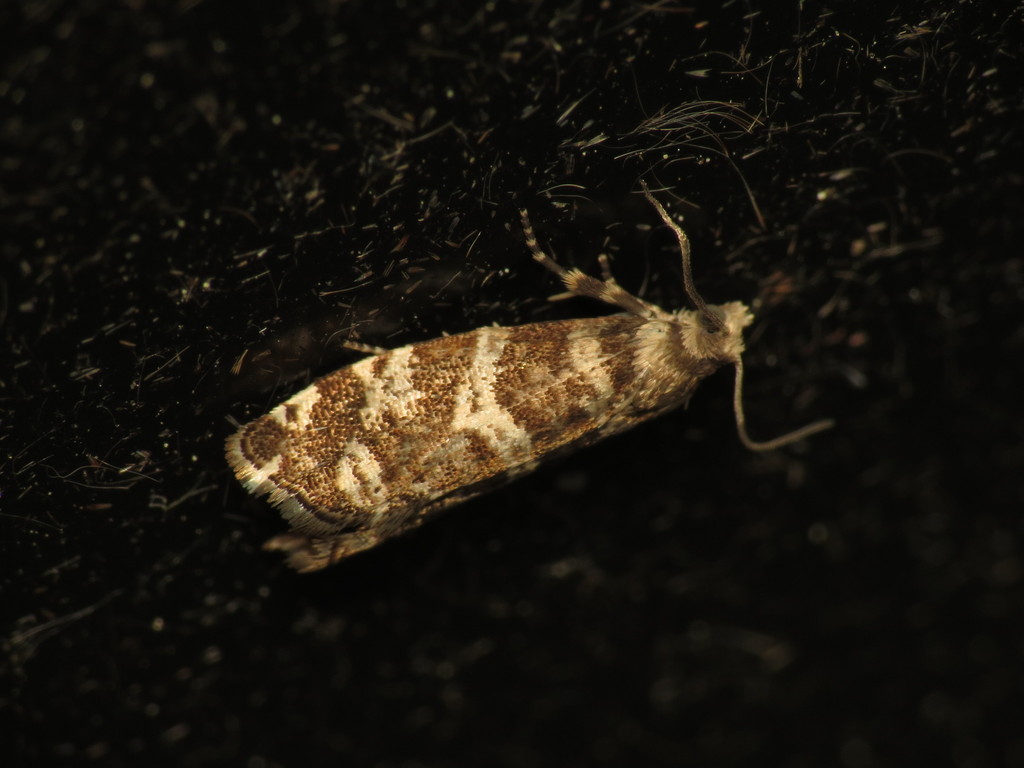
Common Spruce Bell
Epinotia tedella
Insectstrong against fungi, fish
Common
Swarm
While active with another insect in play, each of its attacks also hits the opposing bench for 10, without knocking them out (20 with two others).
39

39
Common Spruce Bell
Epinotia tedella
Insectstrong against fungi, fish
Common
While active with another insect in play, each of its attacks also hits the opposing bench for 10, without knocking them out (20 with two others).
Epinotia tedella
Photo: © Donald Hobern (original photo) · CC BY 4.0 (licence text) · cropped
Strong against: it deals 20% more damage to them. Weak against: these types deal 20% more damage to it.
Epinotia tedella is a moth of the family Tortricidae. It is found in Europe.
The wingspan is 10–13 mm. The face and palpi are whitish. The forewings are pale brownish, strigulated or often wholly suffused with dark fuscous. The costa is posteriorly strigulated with white. Sometimes there is a whitish fascia within the basal patch. The central fascia is narrowed towards the costa and limited by two pairs of silvery-white or grey sometimes almost obsolete striae, the first somewhat curved, the second somewhat interrupted in middle. The posterior of the disc is often whitish-mixed. The termen is hardly sinuate. There is a white subapical dash in cilia. The hindwings are grey. The larva is green with a subdorsal line rather broad, reddish-grey; head and plate of 2 black.
The moth flies in one generation from April to June. In warm years there can be a second generation in August.
The larvae mainly feed on Norway spruce.
Excerpt from the Wikipedia article Epinotia tedella, by its authors, under the CC BY-SA 4.0 licence.
No global status on the IUCN Red List: that’s what makes this card Common.
Every Common card has 100 points, shared between HP, ATK and DEF:
How they’re shared out:

 DEF 39