 …
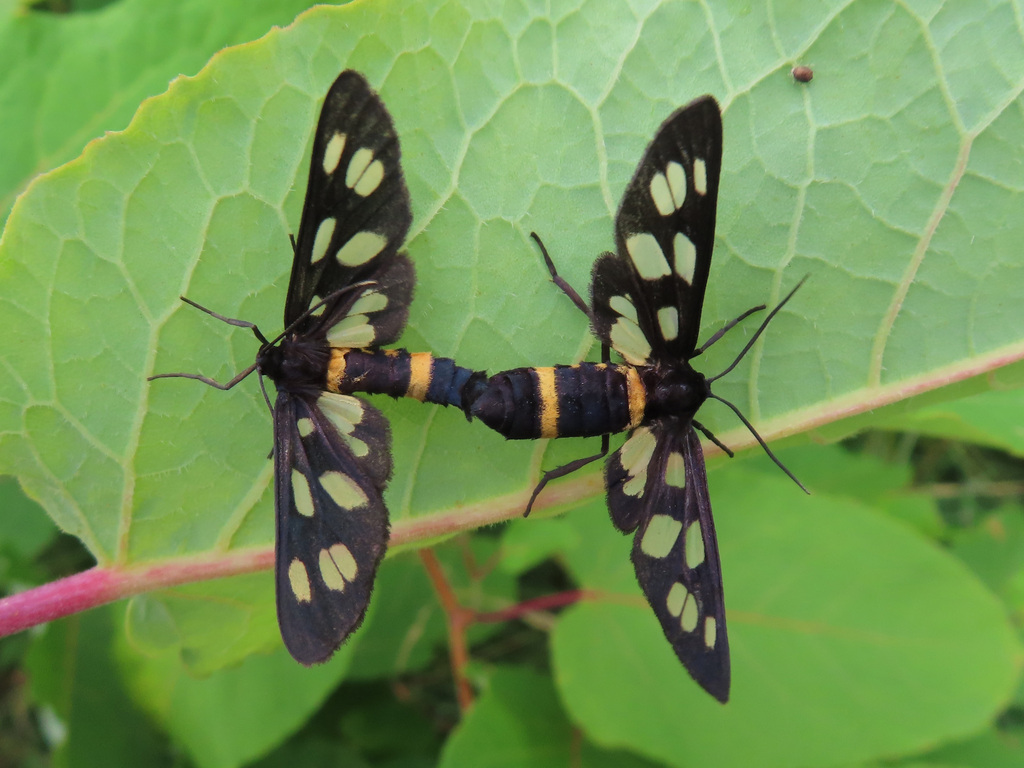
Japanese Nine-spotted Moth
Amata fortunei
Insectstrong against fungi, fish
Common
Swarm
While active with another insect in play, each of its attacks also hits the opposing bench for 10, without knocking them out (20 with two others).
31

38
Japanese Nine-spotted Moth
Amata fortunei
Insectstrong against fungi, fish
Common
While active with another insect in play, each of its attacks also hits the opposing bench for 10, without knocking them out (20 with two others).
Amata fortunei
Photo: © Timur Kalininsky (original photo) · CC BY 4.0 (licence text) · cropped
Strong against: it deals 20% more damage to them. Weak against: these types deal 20% more damage to it.
Amata fortunei, the white-spotted moth, is a moth of the family Erebidae. The species was first described by d'Orza in 1869. It is found in Japan, South Korea and Taiwan.
The wingspan is 30–37 mm. It is a day-flying species. There are two generations per year, with adults on wing from early June to mid July and again from mid August to mid September.
The larvae feed on the leaves of Trifolium repens, Taraxacum species, Equisetum arvense and Typha angustifolia. They are known to eat dead leaves as well as living tissue.
Excerpt from the Wikipedia article Amata fortunei, by its authors, under the CC BY-SA 4.0 licence.
No global status on the IUCN Red List: that’s what makes this card Common.
Every Common card has 100 points, shared between HP, ATK and DEF:
How they’re shared out:

 DEF 38