 …
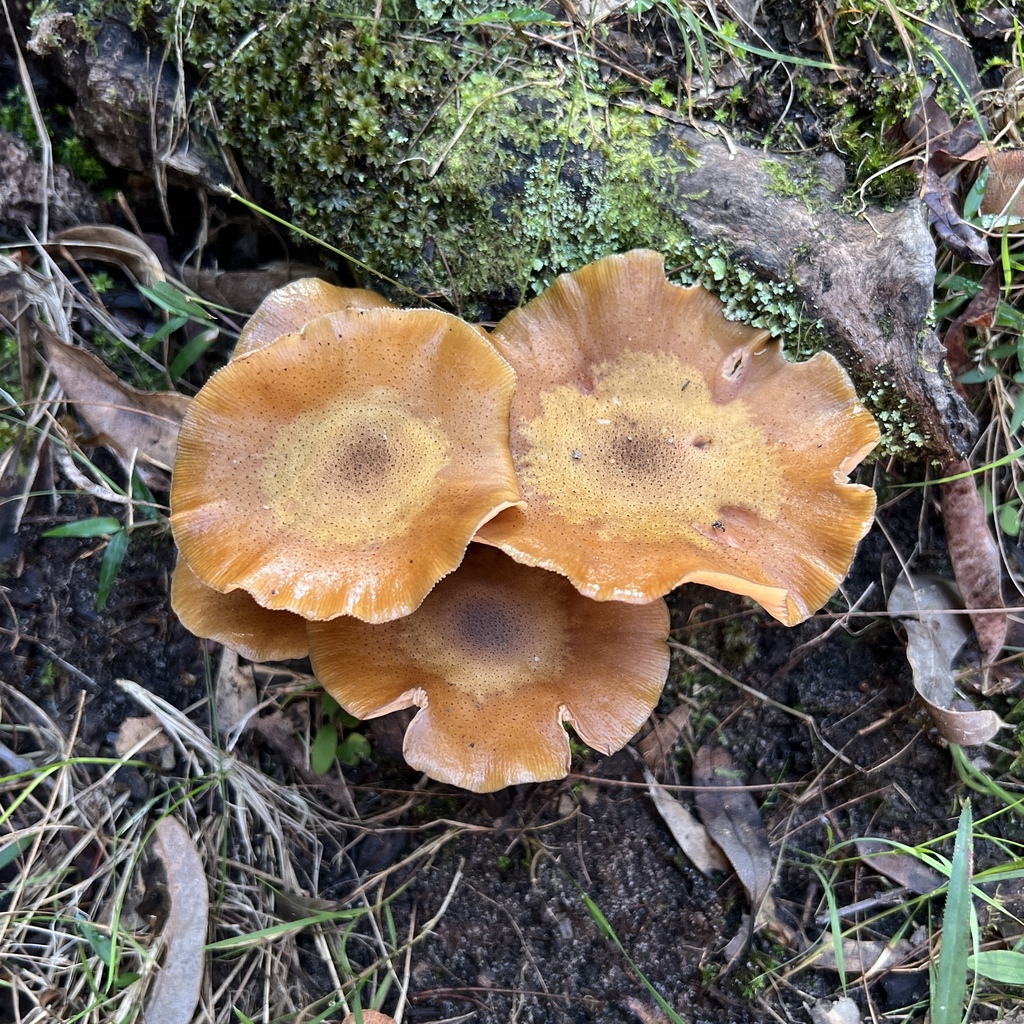
Australian honey fungus
Armillaria luteobubalina
Fungusstrong against amphibians, reptiles
Common
Mycelium
While active with another fungus in play, it regains 5 HP at the start of your turn (8 with two others).
39

28
Australian honey fungus
Armillaria luteobubalina
Fungusstrong against amphibians, reptiles
Common
While active with another fungus in play, it regains 5 HP at the start of your turn (8 with two others).
Armillaria luteobubalina
Photo: © James K. Douch (original photo) · CC BY-SA 4.0 (licence text) · cropped
Strong against: it deals 20% more damage to them. Weak against: these types deal 20% more damage to it.
Armillaria luteobubalina, commonly known as the Australian honey fungus, is a species of root rot fungus in the family Physalacriaceae.
It was first described in 1978, after having been discovered several years earlier growing in a Eucalyptus plantation in southeastern Australia. It distinguished itself from other known Australian Armillaria species by its aggressive pathogenicity. It may take years for infected trees to show signs of disease, leading to an underestimation of disease prevalence. Studies show that the spread of disease in eucalypt forests is associated with infected stumps left following logging operations. Although several methods have been suggested to control the spread of disease, they are largely economically or environmentally unfeasible. Phylogenetic analyses have determined that A. luteobubalina is closely related to A. montagnei and that both of these species are in turn closely related to the Brazilian species A. paulensis. The distribution of A. luteobubalina suggests that it is an ancient species that originated before the separation of the precursor supercontinent Gondwana.
Abridged excerpt from the Wikipedia article Armillaria luteobubalina, by its authors, under the CC BY-SA 4.0 licence.
No global status on the IUCN Red List: that’s what makes this card Common.
Every Common card has 100 points, shared between HP, ATK and DEF:
How they’re shared out:

 DEF 28