 …
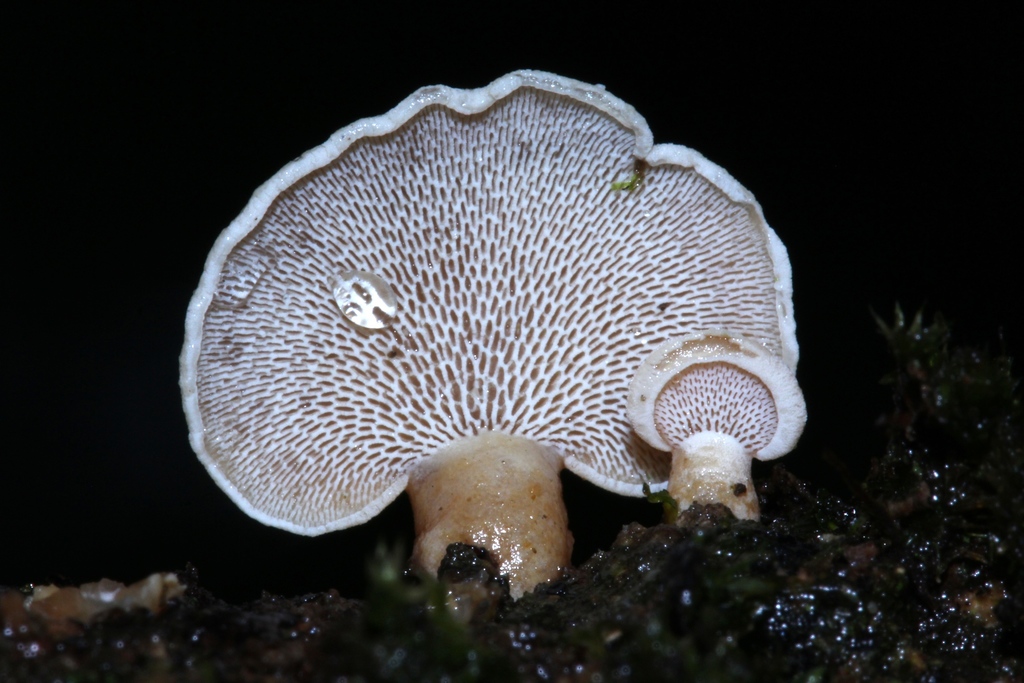
Panellus pusillus
Panellus pusillus
Fungusstrong against amphibians, reptiles
Common
Mycelium
While active with another fungus in play, it regains 5 HP at the start of your turn (8 with two others).
38

29
Panellus pusillus
Panellus pusillus
Fungusstrong against amphibians, reptiles
Common
While active with another fungus in play, it regains 5 HP at the start of your turn (8 with two others).
Panellus pusillus
Photo: © Alan Rockefeller (original photo) · CC BY 4.0 (licence text) · cropped
Strong against: it deals 20% more damage to them. Weak against: these types deal 20% more damage to it.
Panellus pusillus is a species of fungus in the family Mycenaceae. A widely distributed species, it has been recorded in Australia, Asia, Europe, North America, and South America. The fungus was first given its current name in 1975, but has been known by many names since French physician and mycologist Joseph-Henri Léveillé first described it as Gloeoporus pusillus in 1844. A recent molecular phylogenetic study explored the diversity and phylogeny of Panellus, and used species like P. pusillus to identify five new poroid species from China in the genus.
The mushroom develops into flat and broadly round fan- or kidney-shaped caps that measure up to 16 mm broad. The caps go from white to buffish color, and attached to decaying by short stubby stalks that are connected off-center, giving the mushroom it's fan look. Its luminosity has been known for more than half a century and is observable in the fruiting body as well as mycelia both in the wild and in laboratory cultures. The glow is rather weak and requires time to adjust to the dark to be able to notice it, and it isn't often photographed.
It is a common and widely distributed species, often found growing in dense groups or clusters on decaying wood. Modern research has probed the potential of P. pusillus as an alternative tool in lignocellulose pretreatment because of its enzymatic ability in delignification.
Excerpt from the Wikipedia article Panellus pusillus, by its authors, under the CC BY-SA 4.0 licence.
No global status on the IUCN Red List: that’s what makes this card Common.
Every Common card has 100 points, shared between HP, ATK and DEF:
How they’re shared out:

 DEF 29