 …
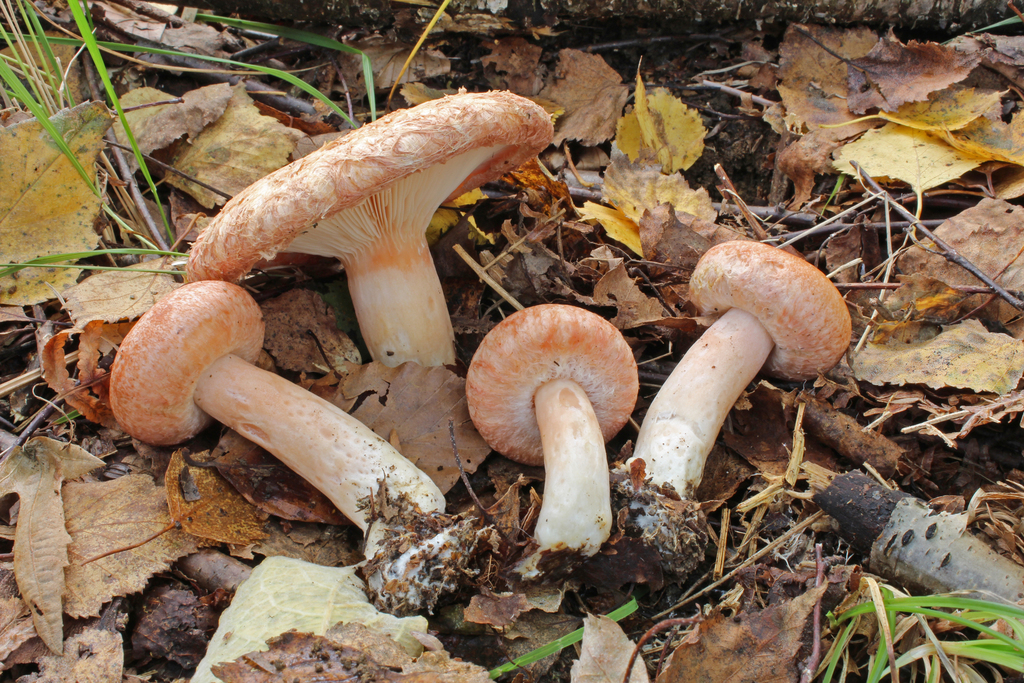
Woolly Milkcap
Lactarius torminosus
Fungusstrong against amphibians, reptiles
Common
Mycelium
While active with another fungus in play, it regains 5 HP at the start of your turn (8 with two others).
40

28
Woolly Milkcap
Lactarius torminosus
Fungusstrong against amphibians, reptiles
Common
While active with another fungus in play, it regains 5 HP at the start of your turn (8 with two others).
Lactarius torminosus
Photo: © Davide Puddu (original photo) · CC BY 4.0 (licence text) · cropped
Strong against: it deals 20% more damage to them. Weak against: these types deal 20% more damage to it.
Lactarius torminosus, commonly known as the woolly milkcap or the bearded milkcap, is a large species of agaric fungus. It was first described scientifically by Jacob Christian Schäffer in 1774 as an Agaricus, and later transferred to the genus Lactarius in 1821 by Samuel Frederick Gray. L. torminosus officially became the type species of Lactarius in 2011 after molecular studies prompted the taxonomic reshuffling of species between several Russulaceae genera.
The caps are convex with a central depression, and attain a diameter of up to 10 cm (4 in). A blend of pink and ochre hues, the cap sometimes has concentric zones of alternating lighter and darker shades. The edge of the cap is rolled inward, and shaggy when young. On the underside of the cap are narrow flesh-colored gills that are crowded closely together. The cylindrical stem is a pale flesh color with a delicately downy surface and brittle flesh; it is up to 8 cm (3 in) long and 0.6–2 cm (1⁄4–3⁄4 in) thick. When cut or injured, the fruit bodies ooze a bitter white latex that does not change color upon exposure to air. The variety nordmanensis, in contrast, has latex that changes from white to yellow. Similar species like L. pubescens or L. villosus differ in morphology and coloration, as well as microscopic characteristics like spore shape and size.
Abridged excerpt from the Wikipedia article Lactarius torminosus, by its authors, under the CC BY-SA 4.0 licence.
Least Concern on the IUCN Red List: that’s what makes this card Common.
Every Common card has 100 points, shared between HP, ATK and DEF:
How they’re shared out:

 DEF 28