 …
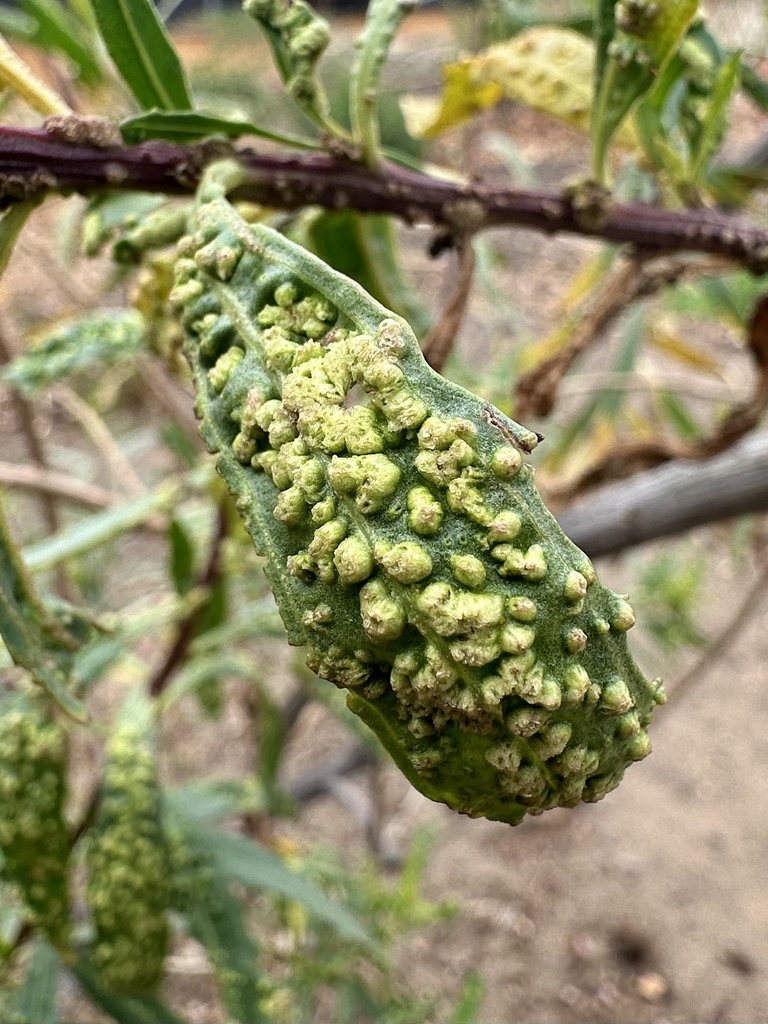
Mule Fat Blister Mite
Aceria baccharices
Arachnidstrong against insects, birds
Common
Venom
While active with another arachnid in play, its target loses 4 HP at the start of each of its turns, as long as it stays active (7 with two others).
51

26
Mule Fat Blister Mite
Aceria baccharices
Arachnidstrong against insects, birds
Common
While active with another arachnid in play, its target loses 4 HP at the start of each of its turns, as long as it stays active (7 with two others).
Aceria baccharices
Photo: © Roberto Daniel Avila (original photo) · CC BY 4.0 (licence text) · cropped
Strong against: it deals 20% more damage to them. Weak against: these types deal 20% more damage to it.
Aceria baccharices, also known as the mulefat leaf-blister mite and formerly known as Eriophyes baccharices, is a species of arachnid native to North America that induces galls on two California willows, Baccharis salicifolia and Baccharis glutinosa. This mite was first described to science by Hartford H. Keifer in 1945. According to Keifer, "the typical host is the long-leaf type Baccharis which is common to dry washes in northern California. The other host is similar but confined to the south." These galls, which look like warty protrusions from the surface of the leaf, are nurseries for the next generation of mites. The adults eventually leave the leaf via anterior exit holes that may be visible.
Aceria baccharices should not confused with Aceria baccharipha, the Baccharis leaf blister mite.
Excerpt from the Wikipedia article Aceria baccharices, by its authors, under the CC BY-SA 4.0 licence.
No global status on the IUCN Red List: that’s what makes this card Common.
Every Common card has 100 points, shared between HP, ATK and DEF:
How they’re shared out:

 DEF 26