 …
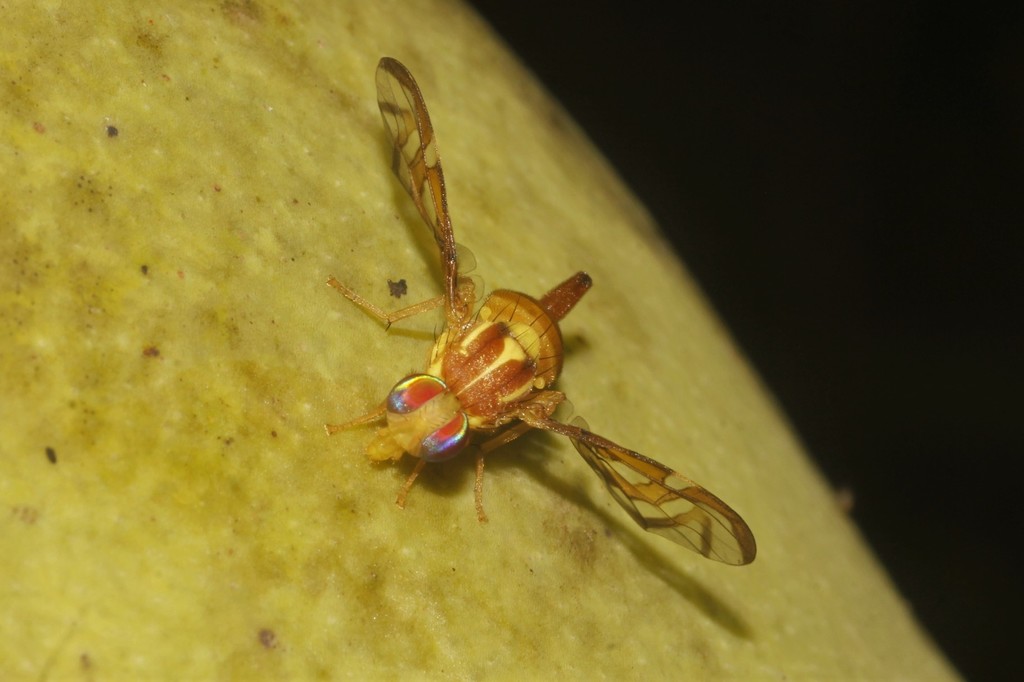
Mexican Fruit Fly
Anastrepha ludens
Insectstrong against fungi, fish
Common
Swarm
While active with another insect in play, each of its attacks also hits the opposing bench for 10, without knocking them out (20 with two others).
39

40
Mexican Fruit Fly
Anastrepha ludens
Insectstrong against fungi, fish
Common
While active with another insect in play, each of its attacks also hits the opposing bench for 10, without knocking them out (20 with two others).
Anastrepha ludens
Photo: © Juan Cruzado Cortés (original photo) · CC BY-SA 4.0 (licence text) · cropped
Strong against: it deals 20% more damage to them. Weak against: these types deal 20% more damage to it.
Anastrepha ludens, the Mexican fruit fly or Mexfly, is a species of fly of the Anastrepha genus in the Tephritidae family (fruit flies). It is closely related to the Caribbean fruit fly Anastrepha suspensa, and the papaya fruit fly Anastrepha curvicauda.
Anastrepha ludens is native to Mexico and Central America and is a major pest to citrus and mango agriculture in Mexico, Central America, and the lower Rio Grande Valley. The species exhibits high fecundity and relatively long lifespans compared to other species of fruit flies. These qualities make the Mexican fruit fly a particularly aggressive invasive species, especially threatening agriculture because the larvae grow and feed on many different species of fruit. The Anastrepha genus is designated as one of three genera that pose the greatest risk to American agriculture. According to the USDA, A. ludens is the only important member of the Anastrepha genus that is subtropical instead of tropical and thus has a range much further North than most Anastrepha species. Also the USDA estimates that the Mexfly causes $1.44 billion worth of damage in a 5-year time span, mostly to citrus farms. They are frequently designated as an invasive species in Southern California and Arizona and pose a serious threat to Florida's grapefruit agriculture.
Excerpt from the Wikipedia article Anastrepha ludens, by its authors, under the CC BY-SA 4.0 licence.
No global status on the IUCN Red List: that’s what makes this card Common.
Every Common card has 100 points, shared between HP, ATK and DEF:
How they’re shared out:

 DEF 40