 …
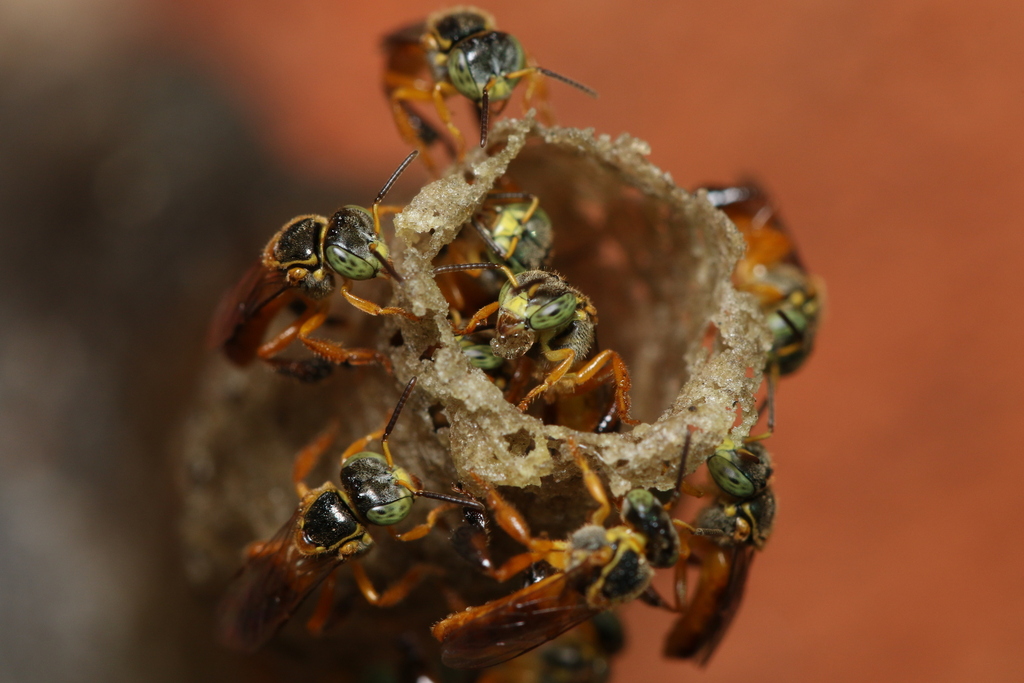
Narrow Stingless Bee
Tetragonisca angustula
Insectstrong against fungi, fish
Common
Swarm
While active with another insect in play, each of its attacks also hits the opposing bench for 10, without knocking them out (20 with two others).
40

38
Narrow Stingless Bee
Tetragonisca angustula
Insectstrong against fungi, fish
Common
While active with another insect in play, each of its attacks also hits the opposing bench for 10, without knocking them out (20 with two others).
Tetragonisca angustula
Photo: © Bruno Henrique Aranda (original photo) · CC BY 4.0 (licence text) · cropped
Strong against: it deals 20% more damage to them. Weak against: these types deal 20% more damage to it.
Tetragonisca angustula is a small eusocial stingless bee found in México, Central and South America. It is known by a variety of names in different regions (e.g., jataí, yatei, jaty, virginitas, angelitas inglesas, españolita, mariola, ramichi, chipisas, virgencitas, and mariolitas). A subspecies, Tetragonisca angustula fiebrigi, occupies different areas in South America and has a slightly different coloration.
Tetragonisca angustula is a very small bee and builds unobtrusive nests, allowing it to thrive in urban areas. It also produces large amounts of honey, and is thus frequently kept in wooden hives by beekeepers. T. angustula hives are often overlooked, and since the bee lacks a stinger, it is not seen as a threat to humans.
Many of their behaviors are concerned with colonizing a new nest and producing offspring, demonstrated by their swarming and nursing behaviors; however, a special caste of T. angustula are soldiers who are slightly larger than the workers. The soldiers in a T. angustula nest are very good at protecting the hive against intruders, making up for the lack of a stinger in their species. The accuracy of their recognition between nestmate and non-nestmate is some of the highest among bees. Some of these soldiers hover in mid air outside the nest, which is seen in the adjacent picture.
Excerpt from the Wikipedia article Tetragonisca angustula, by its authors, under the CC BY-SA 4.0 licence.
No global status on the IUCN Red List: that’s what makes this card Common.
Every Common card has 100 points, shared between HP, ATK and DEF:
How they’re shared out:

 DEF 38