 …
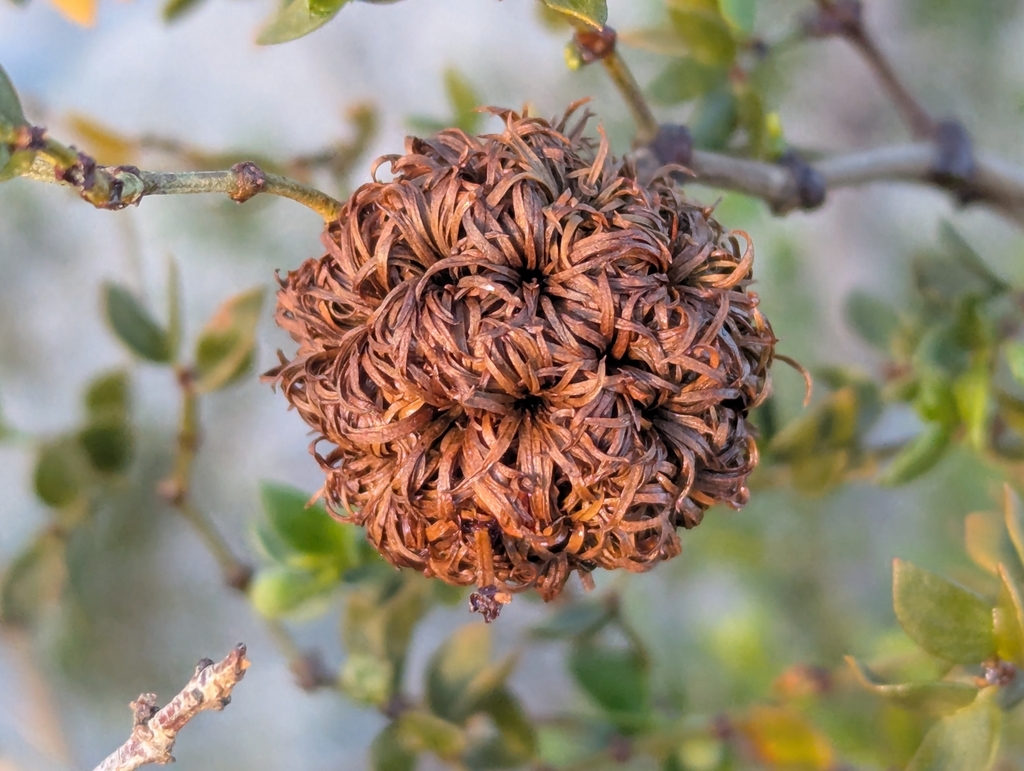
Large Creosote Gall Midge
Asphondylia auripila
Insectstrong against fungi, fish
Common
Swarm
While active with another insect in play, each of its attacks also hits the opposing bench for 10, without knocking them out (20 with two others).
31

40
Large Creosote Gall Midge
Asphondylia auripila
Insectstrong against fungi, fish
Common
While active with another insect in play, each of its attacks also hits the opposing bench for 10, without knocking them out (20 with two others).
Asphondylia auripila
Photo: © Alexander Wentworth (original photo) · CC BY 4.0 (licence text) · cropped
Strong against: it deals 20% more damage to them. Weak against: these types deal 20% more damage to it.
Asphondylia auripila, the large creosote gall midge, is a species of gall midge in the family Cecidomyiidae. This species utilizes creosote bushes as host plants for forming galls. This species of midge can be found in southwestern North America, spanning around U.S. and Mexico states such as California, Nevada, Arizona, Utah, New Mexico, Texas, Sonora, Chihuahua, Baja California, and Baja California Sur. The habitat of this species is based in deserts, spanning from the Mojave Desert to the Baja California Desert and Chihuahuan Desert of Mexico. Adults grow around 4 millimeters in length and appear brown-orange in coloration, but can be difficult to tell apart from other species due to looking morphologically similar. The galls of this midge can be identified by their spherical shape, bushy/leafy appearance, and green coloration for developing midges. Galls begin to turn brown after fully developed midges emerge. These midges create galls when females utilize their ovipositor to insert eggs into the host plant along with a fungal spore from the mycangia (A specialized body part used for transporting fungi). This fungi causes the plant to begin growing a gall while the fungal mycelium grows to line the inside of the gall. The eggs inside then hatch and the larvae feed on the mycelium before eventually developing into adults and emerge from the gall. The galls do not appear to cause the host plant any harm.
Abridged excerpt from the Wikipedia article Asphondylia auripila, by its authors, under the CC BY-SA 4.0 licence.
No global status on the IUCN Red List: that’s what makes this card Common.
Every Common card has 100 points, shared between HP, ATK and DEF:
How they’re shared out:

 DEF 40