 …
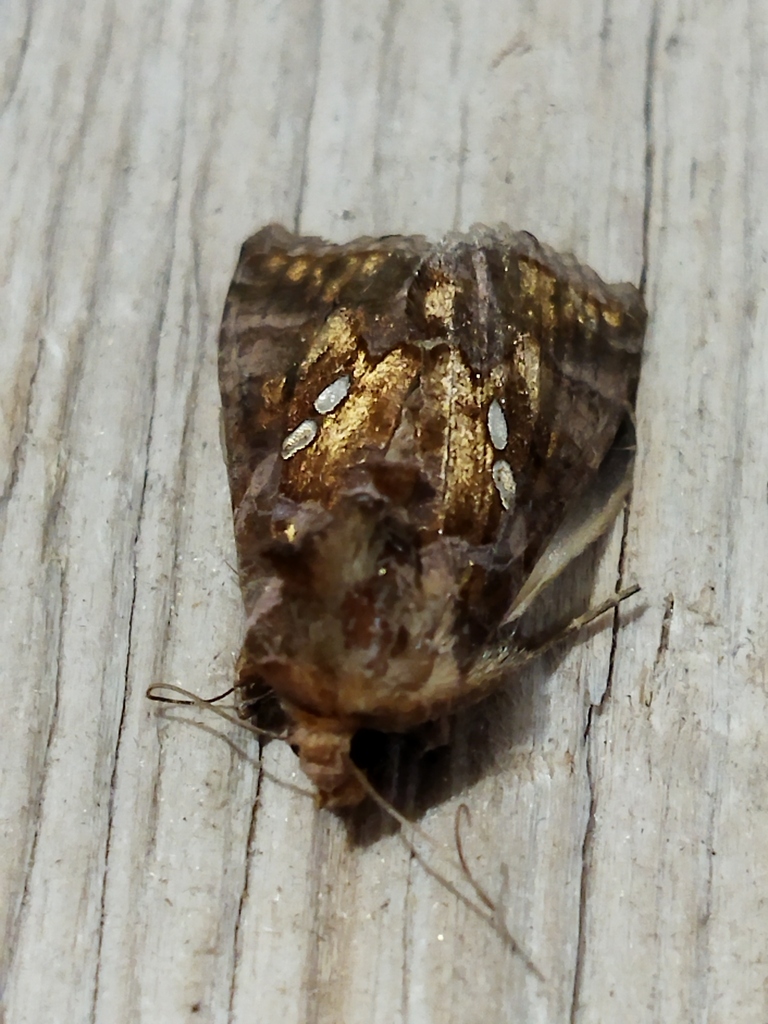
Tomato Looper
Chrysodeixis chalcites
Insectstrong against fungi, fish
Common
Swarm
While active with another insect in play, each of its attacks also hits the opposing bench for 10, without knocking them out (20 with two others).
39

38
Tomato Looper
Chrysodeixis chalcites
Insectstrong against fungi, fish
Common
While active with another insect in play, each of its attacks also hits the opposing bench for 10, without knocking them out (20 with two others).
Chrysodeixis chalcites
Photo: © SteveM4560 (original photo) · CC BY 4.0 (licence text) · cropped
Strong against: it deals 20% more damage to them. Weak against: these types deal 20% more damage to it.
Chrysodeixis chalcites, the tomato looper or golden twin-spot moth, is a moth of the family Noctuidae, subfamily Plusiinae. It mainly lives in southern Europe, the Levant and tropical Africa, but can be seen migrating across much of Europe. In 2013, it was spotted in Canada. It is an important horticultural pest in New Zealand.
The length of the forewings is 15–18 mm. The moth flies from June to October.
The larvae feed on various herbaceous plants, such as Echium vulgare, Apium, Rubus, tomato, Fragaria and tobacco which is why it is perceived as a pest.
Chrysodeixis chalcites and Chrysodeixis eriosoma moths cannot be separated morphologically and they may be sibling species. They are distinguished by DNA, pheromones and geographic origin, as C. chalcites is found in the palearctic and C. eriosoma in the tropics and subtropics. The literature referring to C. chalcites in southern and eastern Asia or Oceania may actually refer to C. eriosoma.
Excerpt from the Wikipedia article Chrysodeixis chalcites, by its authors, under the CC BY-SA 4.0 licence.
No global status on the IUCN Red List: that’s what makes this card Common.
Every Common card has 100 points, shared between HP, ATK and DEF:
How they’re shared out:

 DEF 38