 …
Cornflower Bolete
Gyroporus cyanescens
Fungusstrong against amphibians, reptiles
Common
Mycelium
While active with another fungus in play, it regains 5 HP at the start of your turn (8 with two others).
39

28
Cornflower Bolete
Gyroporus cyanescens
Fungusstrong against amphibians, reptiles
Common
While active with another fungus in play, it regains 5 HP at the start of your turn (8 with two others).
Gyroporus cyanescens
Photo: © mycowalt (original photo) · CC BY-SA 4.0 (licence text) · cropped
Strong against: it deals 20% more damage to them. Weak against: these types deal 20% more damage to it.
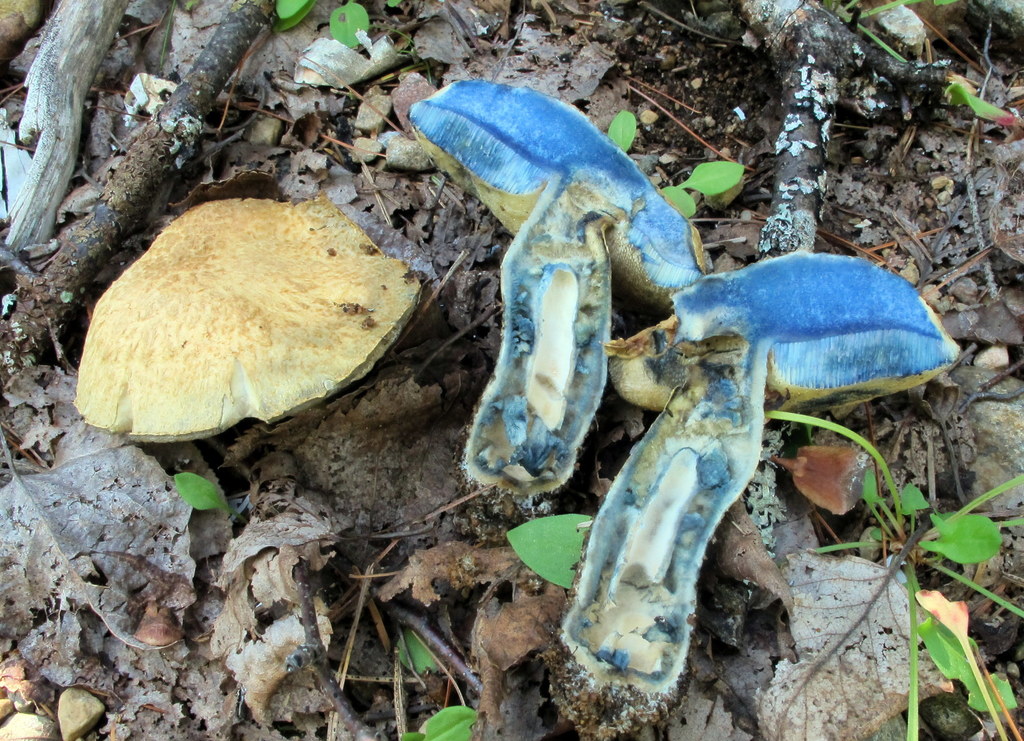
Gyroporus cyanescens, commonly known as the bluing bolete or the cornflower bolete, is a species of bolete fungus in the family Gyroporaceae. First described from France in 1788, the species is found in Eurasia, Australia, and eastern North America, where it grows on the ground in coniferous and mixed forests.
The yellowish to buff cap surface is fibrous and roughened, and reaches up to 12 cm (4.7 in) in diameter. The thick stem, roughly the same color as the cap or lighter, is hollowed out into chambers. All parts of the mushroom turn an intense blue color within a few moments of bruising or cutting. The mushroom is edible, despite its hard stem. A less common variety occurs where the color change is to deep violet rather than blue. The bluing reaction results from the enzymatic oxidation of a chemical called gyrocyanin.
Excerpt from the Wikipedia article Gyroporus cyanescens, by its authors, under the CC BY-SA 4.0 licence.
No global status on the IUCN Red List: that’s what makes this card Common.
Every Common card has 100 points, shared between HP, ATK and DEF:
How they’re shared out:

 DEF 28