 …
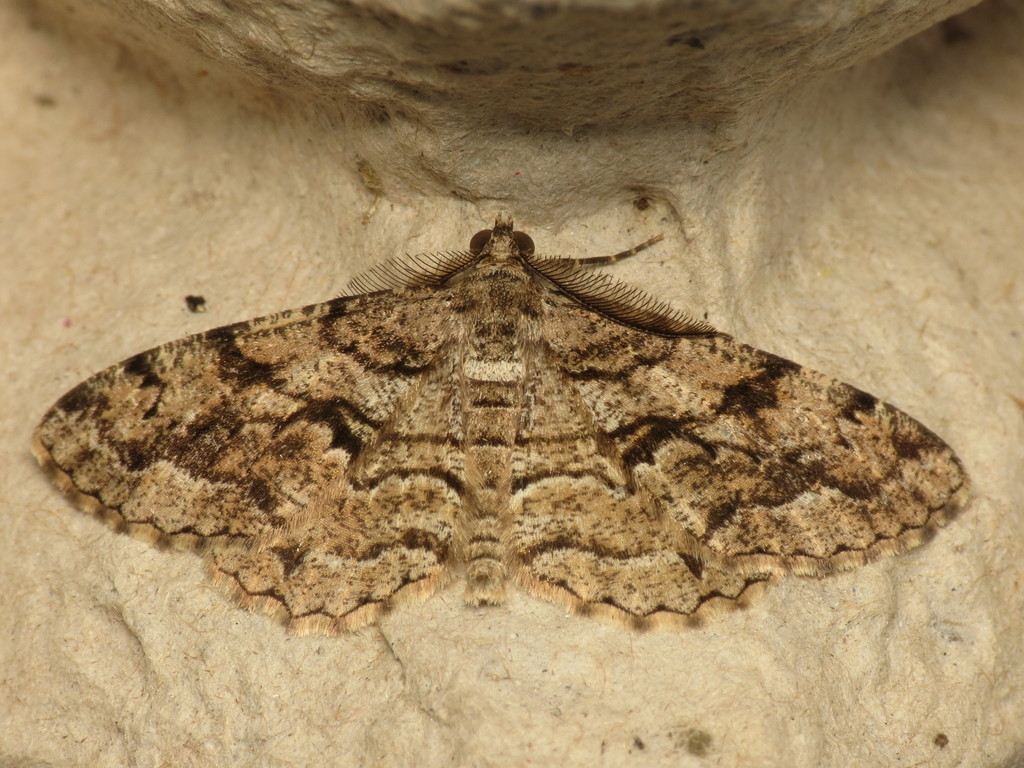
Feathered Beauty
Peribatodes secundaria
Insectstrong against fungi, fish
Common
Swarm
While active with another insect in play, each of its attacks also hits the opposing bench for 10, without knocking them out (20 with two others).
38

41
Feathered Beauty
Peribatodes secundaria
Insectstrong against fungi, fish
Common
While active with another insect in play, each of its attacks also hits the opposing bench for 10, without knocking them out (20 with two others).
Peribatodes secundaria
Photo: © Donald Hobern (original photo) · CC BY 4.0 (licence text) · cropped
Strong against: it deals 20% more damage to them. Weak against: these types deal 20% more damage to it.
Peribatodes secundaria, the feathered beauty, is a moth of the family Geometridae. The species was first described by Michael Denis and Ignaz Schiffermüller in 1775. It can be found in Europe.
The wingspan is 38–44 mm. The length of the forewings is 17–20 mm. The wing ground colour is grey variously mixed with light brown. The median crossband is dark and partially interrupted. Near the wing outer edge in the middle a light spot is sometimes recognizable. The antennae of the males are strongly feathered in contrast to the filament-shaped of the females.
Peribatodes secundaria is difficult to certainly distinguish from its congeners Peribatodes rhomboidaria ([Denis & Schiffermüller], 1775), Peribatodes ilicaria (Geyer, 1833), Deileptenia ribeata (Clerck, 1759) and Alcis repandata (Linnaeus, 1758)
The moth flies in one generation from mid-June to mid-August.
The larva feeds on various coniferous trees, such as the Norway spruce.
Excerpt from the Wikipedia article Peribatodes secundaria, by its authors, under the CC BY-SA 4.0 licence.
No global status on the IUCN Red List: that’s what makes this card Common.
Every Common card has 100 points, shared between HP, ATK and DEF:
How they’re shared out:

 DEF 41