 …
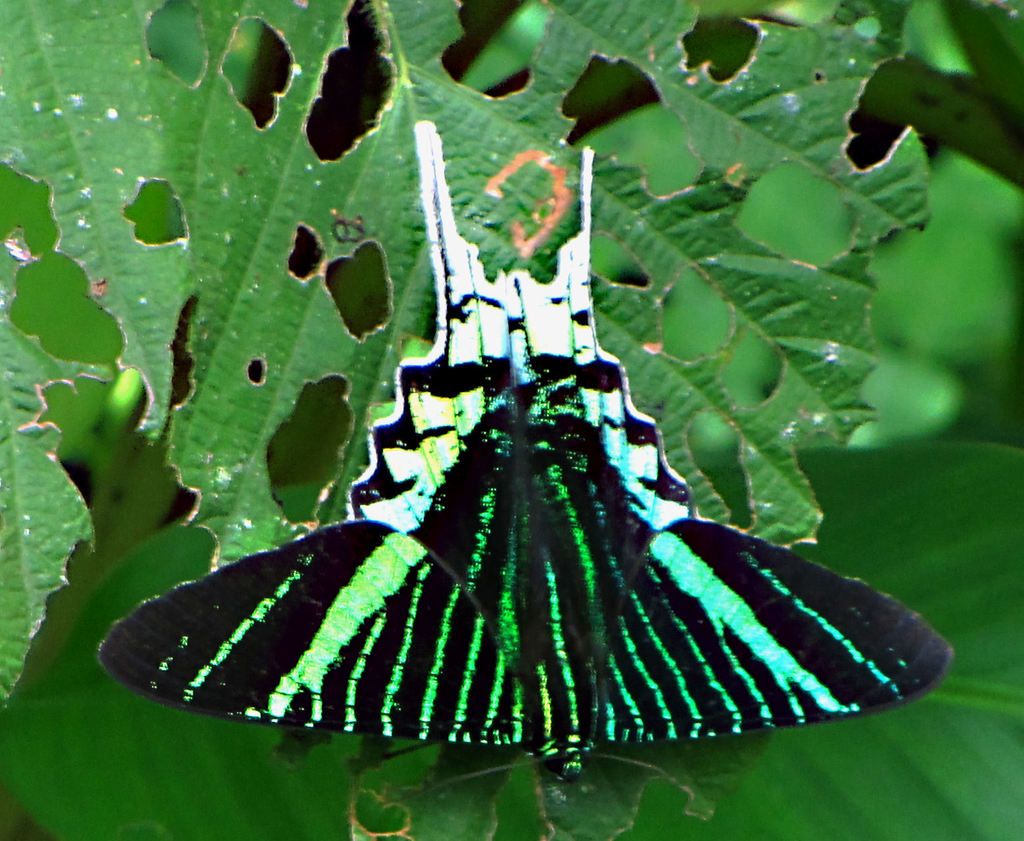
Green-banded Urania
Urania leilus
Insectstrong against fungi, fish
Common
Swarm
While active with another insect in play, each of its attacks also hits the opposing bench for 10, without knocking them out (20 with two others).
30

39
Green-banded Urania
Urania leilus
Insectstrong against fungi, fish
Common
While active with another insect in play, each of its attacks also hits the opposing bench for 10, without knocking them out (20 with two others).
Urania leilus
Photo: © D. Gordon E. Robertson (original photo) · CC BY-SA 4.0 (licence text) · cropped
Strong against: it deals 20% more damage to them. Weak against: these types deal 20% more damage to it.
Urania leilus, the green-banded urania, is a day-flying moth of the family Uraniidae. The species was first described by Carl Linnaeus in his 1758 10th edition of Systema Naturae. It is found in tropical South America east of the Andes, especially in the Amazon rainforest. Its range includes Suriname, Guyana, French Guiana, eastern Colombia, Venezuela, eastern Ecuador, Brazil, northern Bolivia, eastern Peru, as well as the island of Trinidad. It has been recorded as a vagrant to the central and northern Lesser Antilles, such as St. Kitts, Barbados and Dominica. Their preferred habitat consists of riverbanks, in primary and secondary rainforest, at elevations between sea level and about 800 m (2,600 ft).
U. leilus is sometimes confused with the similar-looking U. fulgens, but that species has a separate distribution (west of the Andes in South America, Central America and Mexico) and is slightly smaller with less white to the "tail". Historically, the two have been treated as conspecific. It is theorized that these moths were once part of a single species, but were split into two when the Andean mountains formed about 5–2.7 million years ago, resulting in them becoming allopatric species. Whereas U. leilus is highly dependent in high rainfall, U. fulgens also tolerates habitats with somewhat lower rainfall levels.
Abridged excerpt from the Wikipedia article Urania leilus, by its authors, under the CC BY-SA 4.0 licence.
No global status on the IUCN Red List: that’s what makes this card Common.
Every Common card has 100 points, shared between HP, ATK and DEF:
How they’re shared out:

 DEF 39