 …
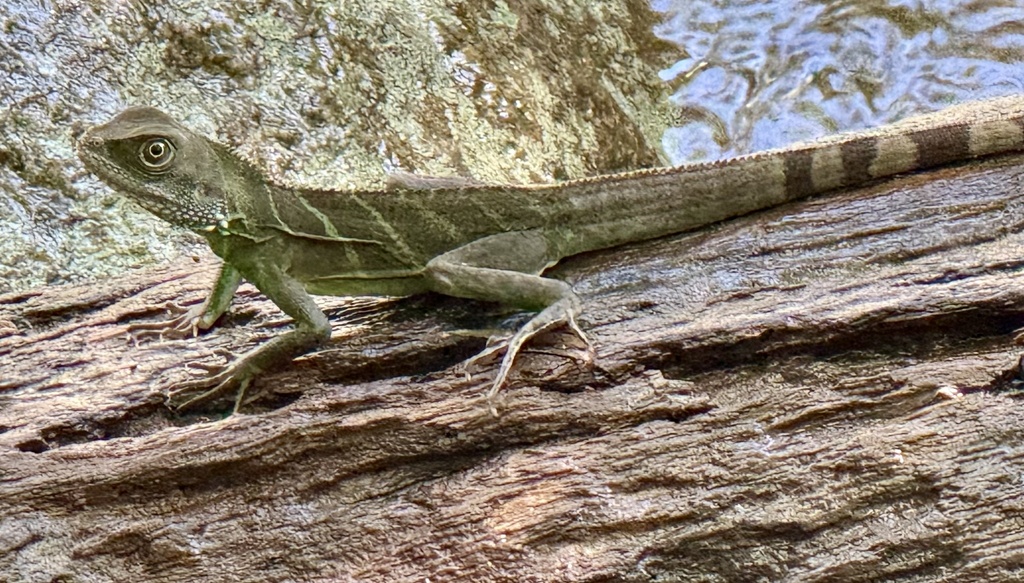
Asian Water Dragon
Physignathus cocincinus
Reptilestrong against amphibians, mammals
Rare
Scales
While active with another reptile in play, it takes 3 less damage (6 with two others).
43

47
Asian Water Dragon
Physignathus cocincinus
Reptilestrong against amphibians, mammals
Rare
While active with another reptile in play, it takes 3 less damage (6 with two others).
Physignathus cocincinus
Photo: © rjtizard (original photo) · CC BY 4.0 (licence text) · cropped
Strong against: it deals 20% more damage to them. Weak against: these types deal 20% more damage to it.
Physignathus cocincinus is a species of agamid lizard native to southern China and mainland Southeast Asia. It is commonly known as the Chinese water dragon, Indochinese water dragon, Asian water dragon, Thai water dragon, or green water dragon.
Chinese water dragons are large diurnal lizards adapted for dense subtropical forests replete with unpolluted streams. They are semi-arboreal, roosting at night on branches overlooking streams, which offer an escape route when the lizards are disturbed. Arthropods are their main source of food, though worms, snails, vertebrates, and plants make up a notable portion of the diet as well. Males are territorial towards each other and bear display features such as crests and jowls. Females are oviparous and reproduce sexually in the wild, though at least one captive Chinese water dragon is known to have reproduced via parthenogenesis. Physignathus cocincinus is related to Australasian lizards in the subfamily Amphibolurinae. One amphibolurine, the Australian water dragon (Intellagama lesuerii) is so anatomically and ecologically similar to Physignathus cocincinus that it was once (erroneously) placed in the same genus.
Abridged excerpt from the Wikipedia article Chinese water dragon, by its authors, under the CC BY-SA 4.0 licence.
Vulnerable on the IUCN Red List: that’s what makes this card Rare.
Every Rare card has 130 points, shared between HP, ATK and DEF:
How they’re shared out:

 DEF 47