 …
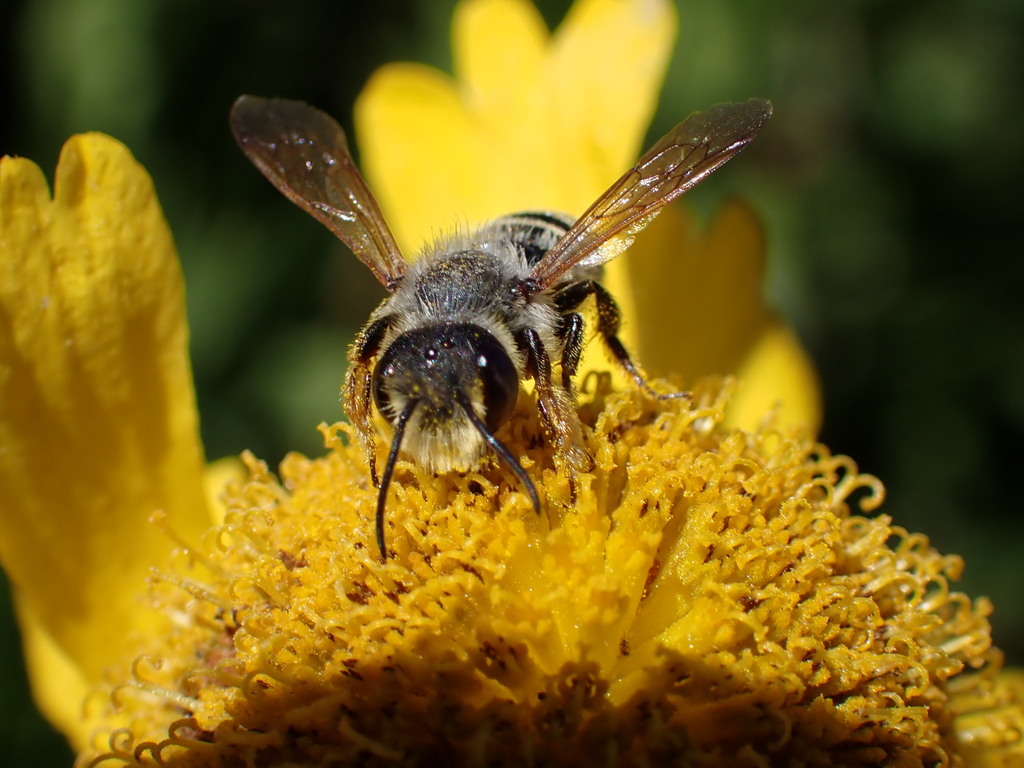
Horn-faced Leafcutter Bee
Megachile fidelis
Insectstrong against fungi, fish
Common
Swarm
While active with another insect in play, each of its attacks also hits the opposing bench for 10, without knocking them out (20 with two others).
40

39
Horn-faced Leafcutter Bee
Megachile fidelis
Insectstrong against fungi, fish
Common
While active with another insect in play, each of its attacks also hits the opposing bench for 10, without knocking them out (20 with two others).
Megachile fidelis
Photo: © Chris Fluit (original photo) · CC BY 4.0 (licence text) · cropped
Strong against: it deals 20% more damage to them. Weak against: these types deal 20% more damage to it.
Megachile fidelis, the faithful leafcutting bee, is a species of bee in the family Megachilidae.
This species is found in the western United States, where it ranges from Montana and South Dakota to New Mexico, west to California and north to Oregon, and often inhabits meadows and gardens. The bee is black, but covered by golden/yellow hair on its face, behind its eyes, on its thorax, below its wings (which are blackish) and on its legs. The pollen basket of the species is located under its abdomen. As often found with most bees, Megachile fidelis feeds on the nectar of flowers - particularly the nectar of composite flowers. The nests of M. fidelis are created in almost exactly the same fashion as, M. perihirta, the Western Leafcutting Bee. However, adult bees do not leave their brood cells until all the cells between their cell and the end of the tunnel have been vacated. As with the case of many bees, larva grow extremely rapidly when in their brood cells. It is often found that this species of bee leave their nests around spring.
The species was first described by Ezra Townsend Cresson in 1878.
Excerpt from the Wikipedia article Megachile fidelis, by its authors, under the CC BY-SA 4.0 licence.
No global status on the IUCN Red List: that’s what makes this card Common.
Every Common card has 100 points, shared between HP, ATK and DEF:
How they’re shared out:

 DEF 39