
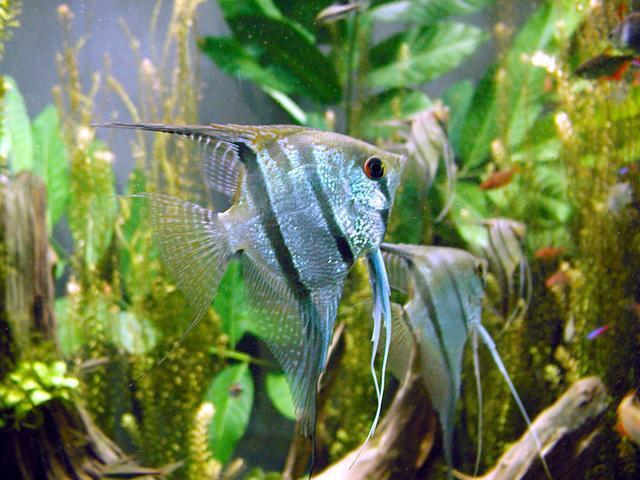
Freshwater Angelfish
Pterophyllum scalare
Fishstrong against mammals, arachnids
Common
While active with another fish in play, a fish on your bench absorbs up to 9 of the damage this card takes, without being knocked out (18 with two others).

Freshwater Angelfish
Pterophyllum scalare
Fishstrong against mammals, arachnids
Common
While active with another fish in play, a fish on your bench absorbs up to 9 of the damage this card takes, without being knocked out (18 with two others).
Pterophyllum scalare
Photo: © mendel (original photo) · CC BY-SA 4.0 (licence text) · cropped
Strong against: it deals 20% more damage to them. Weak against: these types deal 20% more damage to it.
Pterophyllum scalare, most commonly referred to as angelfish or freshwater angelfish, is the most common species of Pterophyllum kept in captivity. It is native to the Amazon Basin in Peru, Colombia, and Brazil. Particularly to the Ucayali river in Peru, the Oyapock River in French Guiana, the Essequibo River in Guyana, the Solimões, the Amapá, and the Amazon rivers in Brazil. It is found in swamps or flooded grounds where vegetation is dense and the water is either clear or silty. Its native waters range from a neutral pH of 7.0 down to near 6.0, with a general water hardness (gH) range of 3 to 10 °dH, and water temperature ranging from 26 to 30 °C (75 to 86 °F). This is the species of angelfish most frequently found in the aquarium trade. A similar (cross-breeding possible) P. scalare exists in the Rio Orinoco. They are of the same size and shape, the only difference being the stripes; the Orinoco P. scalare has thinner, but dual, stripes.
The diet of Pterophyllum scalare consists of a wide spectrum of prey; they feed on tiny fish fry and younger, juvenile fishes, young and mature shrimps, crabs, prawns, various worms, mosquito larvae, and water bugs. Additionally, they will opportunistically catch any smaller-sized floating insects that have fallen onto the surface of the water.
Abridged excerpt from the Wikipedia article Pterophyllum scalare, by its authors, under the CC BY-SA 4.0 licence.
Least Concern on the IUCN Red List: that’s what makes this card Common.
Every Common card has 100 points, shared between HP, ATK and DEF:
How they’re shared out:

