 …
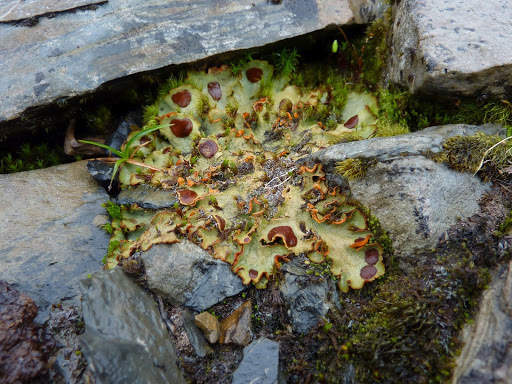
Chocolate Chip Lichen
Solorina crocea
Fungusstrong against amphibians, reptiles
Common
Mycelium
While active with another fungus in play, it regains 5 HP at the start of your turn (8 with two others).
39

29
Chocolate Chip Lichen
Solorina crocea
Fungusstrong against amphibians, reptiles
Common
While active with another fungus in play, it regains 5 HP at the start of your turn (8 with two others).
Solorina crocea
Photo: © 116916927065934112165 (original photo) · CC BY 4.0 (licence text) · cropped
Strong against: it deals 20% more damage to them. Weak against: these types deal 20% more damage to it.
Solorina crocea, commonly known as the orange chocolate chip lichen, is a species of terricolous (ground-dwelling) and foliose (leafy) lichen in the family Peltigeraceae. The lichen, which was first formally described by Carl Linnaeus in 1753, has an arctic–alpine and circumpolar distribution and occurs in Asia, Europe, North America, and New Zealand. It generally grows on the bare ground in sandy soils, often in moist soil near snow patches or seepage areas. Although several forms and varieties of the lichen have been proposed in its history, these are not considered to have any independent taxonomic significance.
The colouration of Solorina crocea is quite distinct, making it readily identifiable: its upper thallus surface is green, while both the undersurface and its internal medulla are bright orange. The orange colour results from a pigment called solorinic acid, one of several secondary compounds that occur in the lichen. The thallus features dark brown discs, usually sunken into the surface, which are apothecia–where spores are produced. The lichen has both blue-green algae and green algae as symbiotic partners (photobionts); they are organized into separate layers in the lichen thallus.
Excerpt from the Wikipedia article Solorina crocea, by its authors, under the CC BY-SA 4.0 licence.
No global status on the IUCN Red List: that’s what makes this card Common.
Every Common card has 100 points, shared between HP, ATK and DEF:
How they’re shared out:

 DEF 29