 …
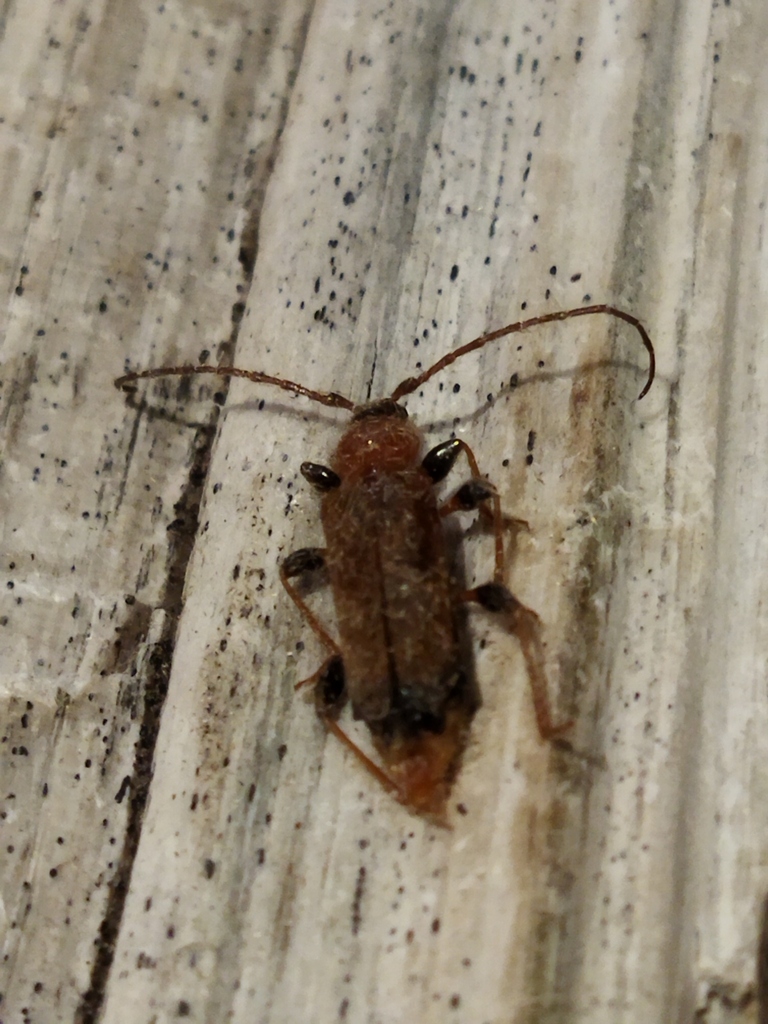
Tanbark Borer
Phymatodes testaceus
Insectstrong against fungi, fish
Common
Swarm
While active with another insect in play, each of its attacks also hits the opposing bench for 10, without knocking them out (20 with two others).
41

37
Tanbark Borer
Phymatodes testaceus
Insectstrong against fungi, fish
Common
While active with another insect in play, each of its attacks also hits the opposing bench for 10, without knocking them out (20 with two others).
Phymatodes testaceus
Photo: © SteveM4560 (original photo) · CC BY 4.0 (licence text) · cropped
Strong against: it deals 20% more damage to them. Weak against: these types deal 20% more damage to it.
Phymatodes testaceus (commonly known as the tanbark borer, or the violet tanbark beetle) is a transpalearctic polymorphic species of beetle in the subfamily Cerambycinae in the longhorn beetle family.
The P. testaceus imago is typically 6–16 mm in length. Their eggs are 1 mm long, and in athwart 0.5 mm. Larvae of the species are 10–18 mm long and 2.1 mm wide. Pupa are 9 mm long, and the abdomen is 2.8 mm wide.
Distribution of these beetle extends from the European Atlantic coastline to the Southern Ural Mountains, from southern Sweden and Norway to North Africa and Syria. It is also distributed throughout Japan and North America.
Larvae develop in and under the bark of various deciduous tree species, causing damage. Larvae pupate in the spring. The beetle's life cycle lasts one year in central and southern parts, and two years in northern climes.
Excerpt from the Wikipedia article Phymatodes testaceus, by its authors, under the CC BY-SA 4.0 licence.
No global status on the IUCN Red List: that’s what makes this card Common.
Every Common card has 100 points, shared between HP, ATK and DEF:
How they’re shared out:

 DEF 37