 …
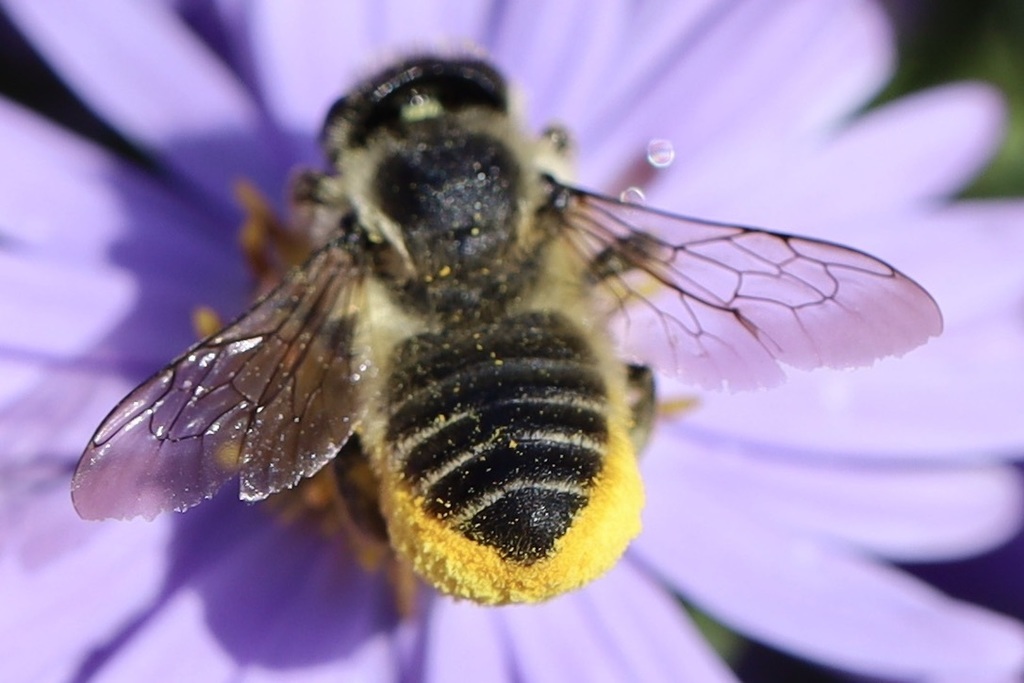
Western Leafcutter Bee
Megachile perihirta
Insectstrong against fungi, fish
Common
Swarm
While active with another insect in play, each of its attacks also hits the opposing bench for 10, without knocking them out (20 with two others).
40

38
Western Leafcutter Bee
Megachile perihirta
Insectstrong against fungi, fish
Common
While active with another insect in play, each of its attacks also hits the opposing bench for 10, without knocking them out (20 with two others).
Megachile perihirta
Photo: © eebee (original photo) · CC BY 4.0 (licence text) · cropped
Strong against: it deals 20% more damage to them. Weak against: these types deal 20% more damage to it.
Megachile perihirta, commonly known as the Western leafcutting bee, is a bee in the genus Megachile. The bee is native to western North America, ranging from Nebraska to Texas and Mexico, west to California, and north to British Columbia and Alberta, and often inhabits meadows and orchards. The bee is black with long whitish-yellow hair, more so below the thorax and abdomen. The abdomen, however, is mostly bare, although each segment has scattered whitish hair. The wings of the Western leafcutting bee are clear, while their veins are black. The pollen basket below the abdomen is bright red.
Like most bees, adult western leafcutting bees drink nectar, whilst Western leafcutting bee larva feed both on nectar and pollen. Western Leafcutting Bee nests are created when a small group of bees work together to dig small burrows in sand, gravel, soil, or in rotting plants or wood. Inside this burrow it is found that the bees construct a series of cells lined with leaf fragments. Each cell contains pollen and nectar, then one egg is laid inside a cell. Adult Western leafcutting bees are seen normally from July to August, and live around one year.
Excerpt from the Wikipedia article Megachile perihirta, by its authors, under the CC BY-SA 4.0 licence.
No global status on the IUCN Red List: that’s what makes this card Common.
Every Common card has 100 points, shared between HP, ATK and DEF:
How they’re shared out:

 DEF 38