 …
Witch-hazel Cone Gall Aphid
Hormaphis hamamelidis
Insectstrong against fungi, fish
Common
Swarm
While active with another insect in play, each of its attacks also hits the opposing bench for 10, without knocking them out (20 with two others).
39

40
Witch-hazel Cone Gall Aphid
Hormaphis hamamelidis
Insectstrong against fungi, fish
Common
While active with another insect in play, each of its attacks also hits the opposing bench for 10, without knocking them out (20 with two others).
Hormaphis hamamelidis
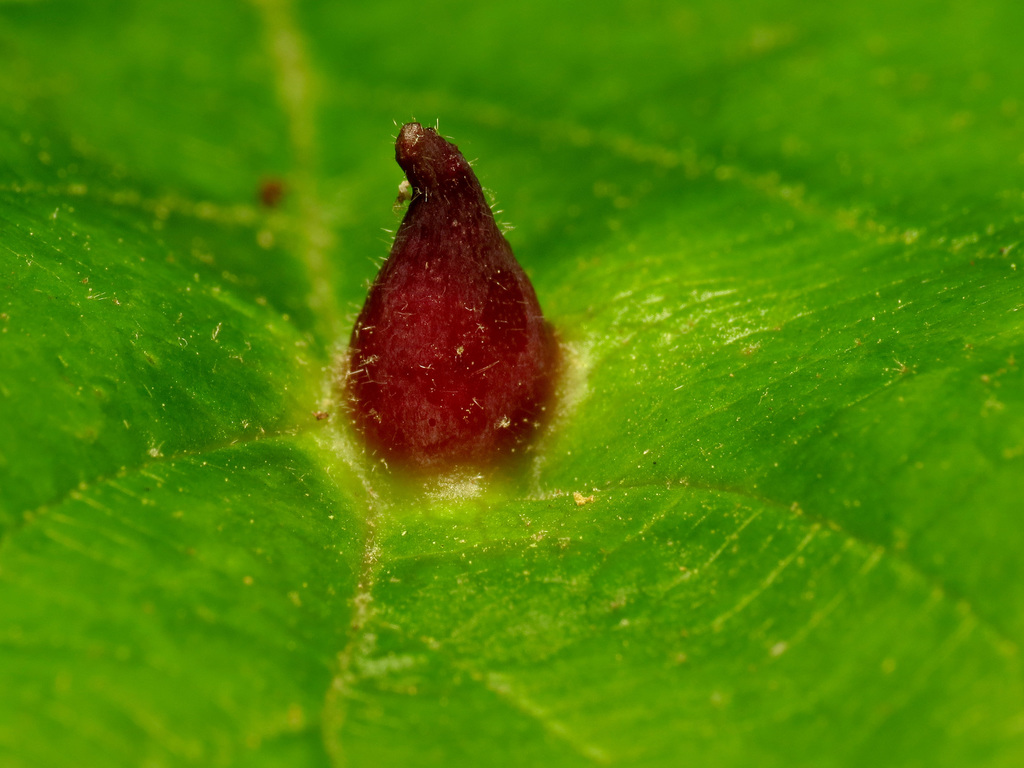
Photo: © Katja Schulz (original photo) · CC BY 4.0 (licence text) · cropped
Strong against: it deals 20% more damage to them. Weak against: these types deal 20% more damage to it.
The witch-hazel cone gall aphid (Hormaphis hamamelidis) is a minuscule insect, a member of the aphid superfamily, whose presence on a witch-hazel (Hamamelis virginiana) plant is easily recognizable by a conical gall structure. The gall is green at first, then turns bright red. This gall, rich in nutrients, provides both food and shelter for the female aphid.
H. hamamelidis have three generations per year, each with a different part in the life cycle. At the start of spring, females or stem mothers crawl to witch-hazel leaf buds. As the leaf grows, the aphid injects it with a substance, possibly an enzyme or hormone, that causes that the galls to form around her. Once inside her gall, the stem mother reproduces parthenogenically and fills the gall with 50–70 female offspring. The second generation develops wings and disperses, repeating the process. The third generation includes both males and females. Towards the end of summer, the third generation reproduces sexually and lays eggs on the bark of the witch-hazel. The cycle begins anew in the following spring.
Abridged excerpt from the Wikipedia article Witch-hazel cone gall aphid, by its authors, under the CC BY-SA 4.0 licence.
No global status on the IUCN Red List: that’s what makes this card Common.
Every Common card has 100 points, shared between HP, ATK and DEF:
How they’re shared out:

 DEF 40