 …
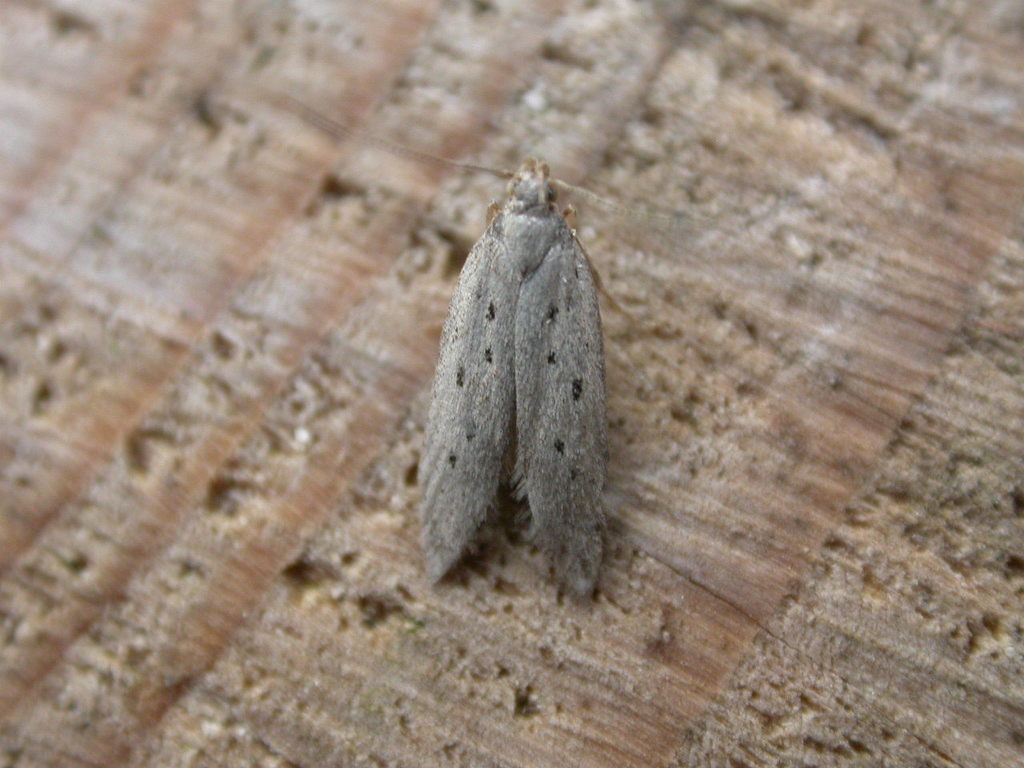
Ten-spotted Honeysuckle Moth
Athrips mouffetella
Insectstrong against fungi, fish
Common
Swarm
While active with another insect in play, each of its attacks also hits the opposing bench for 10, without knocking them out (20 with two others).
29

40
Ten-spotted Honeysuckle Moth
Athrips mouffetella
Insectstrong against fungi, fish
Common
While active with another insect in play, each of its attacks also hits the opposing bench for 10, without knocking them out (20 with two others).
Athrips mouffetella
Photo: © Donald Hobern (original photo) · CC BY 4.0 (licence text) · cropped
Strong against: it deals 20% more damage to them. Weak against: these types deal 20% more damage to it.
Athrips mouffetella, the ten-spotted honeysuckle moth, is a moth of the family Gelechiidae. It is found from central and northern Europe to the Ural Mountains, Siberia and the Russian Far East. It has also been recorded from North America.
The wingspan is about 15 mm. The forewings are light ashy brown, irrorated with paler, faintly rosy-tinged hues. There are some minute black dots near the base and on termen. The stigmata and a dot obliquely beneath and before second discal are black, the first discal is beyond the plical. The hindwings are grey.
The larva is blackish-grey; dorsal line whitish on incisions between 2 and 4; spiracular indistinct, whitish, clearer anteriorly; head and plate of 2 black.
The moths are on wing from June to August depending on the location.
The larvae feed on Lonicera species (including Lonicera periclymenum, Lonicera xylosteum and Lonicera caprifolium), but also Symphoricarpos albus.
Excerpt from the Wikipedia article Athrips mouffetella, by its authors, under the CC BY-SA 4.0 licence.
No global status on the IUCN Red List: that’s what makes this card Common.
Every Common card has 100 points, shared between HP, ATK and DEF:
How they’re shared out:

 DEF 40