 …
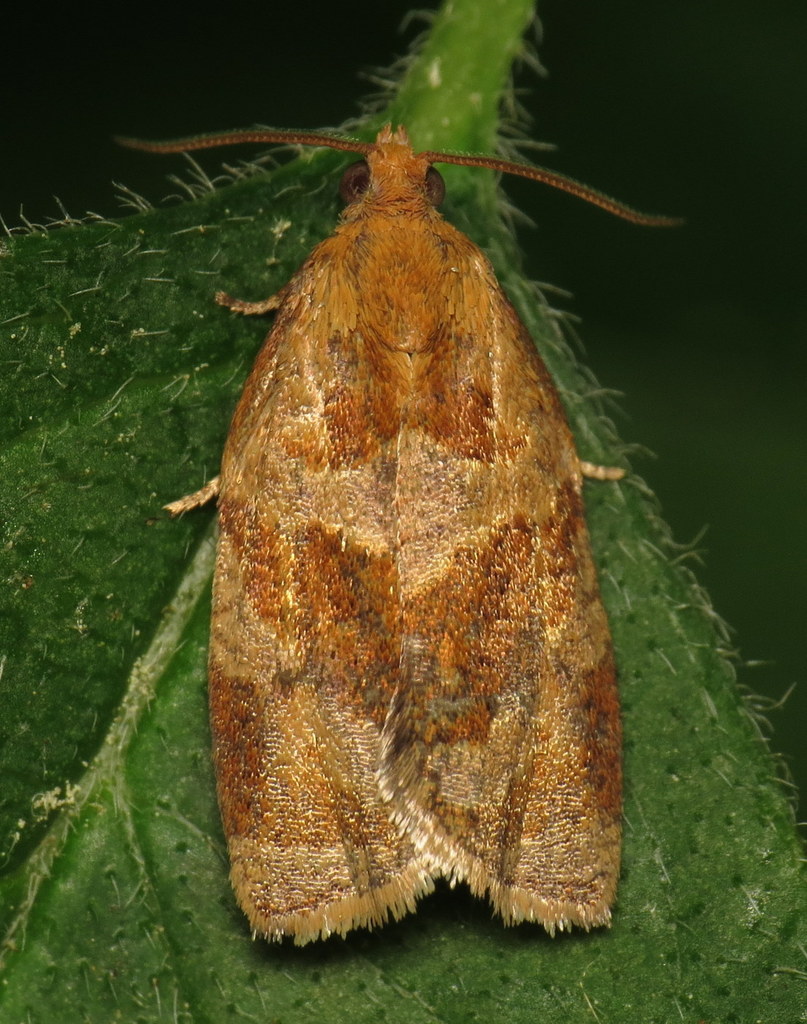
Rose Tortrix Moth
Archips rosana
Insectstrong against fungi, fish
Common
Swarm
While active with another insect in play, each of its attacks also hits the opposing bench for 10, without knocking them out (20 with two others).
39

39
Rose Tortrix Moth
Archips rosana
Insectstrong against fungi, fish
Common
While active with another insect in play, each of its attacks also hits the opposing bench for 10, without knocking them out (20 with two others).
Archips rosana
Photo: © Nick Block (original photo) · CC BY 4.0 (licence text) · cropped
Strong against: it deals 20% more damage to them. Weak against: these types deal 20% more damage to it.
Archips rosana, the rose tortrix, is a moth of the family Tortricidae. It is found in both the Palearctic and Nearctic realms.
The wingspan is 15–24 mm. The forewings have a sinuate, vertical termen. sinuate. The costal fold from base to beyond middle, is irregular and light brown, sometimes reddish-tinged, in female darker-strigulated. There is a dorsal spot near the base. The anterior edge of the central fascia is sinuate. There is a suffused costal patch emitting an interrupted stria darker brown, in the female sometimes nearly obsolete and some dark terminal strigulae. The hindwings are grey, apex usually more or less orange. The larva is dark olive-green; dorsal line darker; tubercular spots white; head brown; plate of 2 blackish, anteriorly whitish. Julius von Kennel provides a full description.
The moths are on wing from May to August depending on the location.
The larvae feed within rolled leaves of various fruit plants such as raspberry, as well as cultivated rose. Pupation takes place from April to May. The species overwinters as an egg.
Excerpt from the Wikipedia article Archips rosana, by its authors, under the CC BY-SA 4.0 licence.
No global status on the IUCN Red List: that’s what makes this card Common.
Every Common card has 100 points, shared between HP, ATK and DEF:
How they’re shared out:

 DEF 39