 …
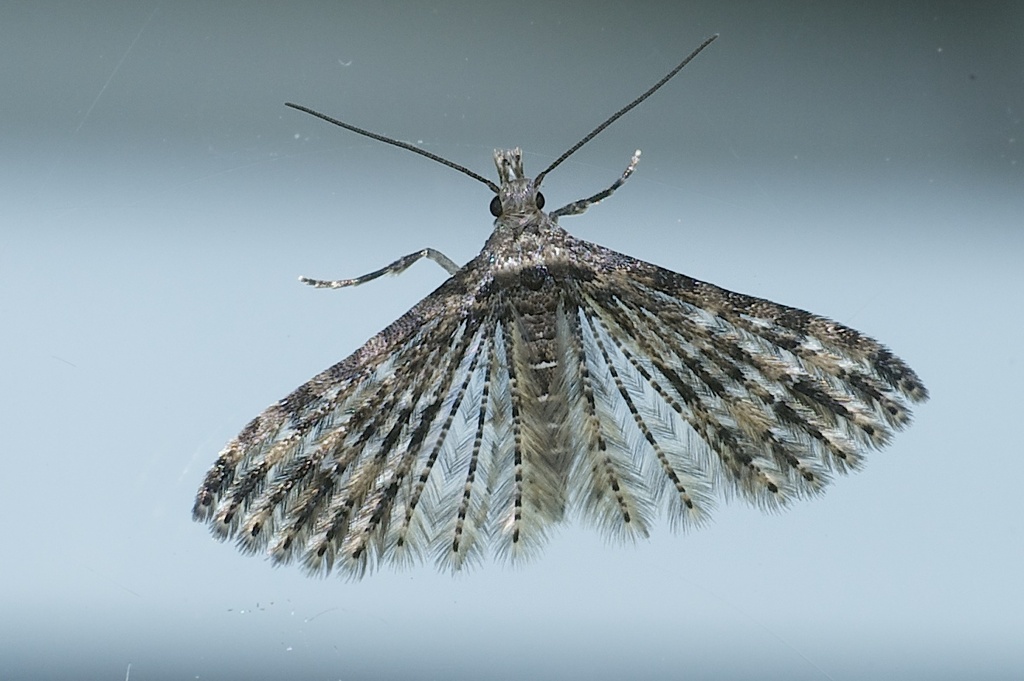
Montana Six-plume Moth
Alucita montana
Insectstrong against fungi, fish
Common
Swarm
While active with another insect in play, each of its attacks also hits the opposing bench for 10, without knocking them out (20 with two others).
40

38
Montana Six-plume Moth
Alucita montana
Insectstrong against fungi, fish
Common
While active with another insect in play, each of its attacks also hits the opposing bench for 10, without knocking them out (20 with two others).
Alucita montana
Photo: © Sterling Sheehy (original photo) · CC BY 4.0 (licence text) · cropped
Strong against: it deals 20% more damage to them. Weak against: these types deal 20% more damage to it.
Alucita montana, the Montana six-plume moth, is a moth of the family Alucitidae. It was described by William Barnes and Arthur Ward Lindsey in 1921. It is found in North America from south-western Quebec and Vermont, west to British Columbia and south to Arizona, California and Texas.
The wingspan is 11–16 mm (0.43–0.63 in). The forewings are crossed by a wide median band, margined narrowly with white, which forks on the first two lobes. There is another band nearer the base on the first lobe which is not distinctly marked elsewhere, and an additional subterminal band which is narrower on the first two lobes. Between this and the median band there is a heavy costal spot which does not reach the inner margin of the first lobe. All of these marks are margined with white. The ground color is grayish tawny and the marks are very dark brown, as are the tips of the lobes. The hindwings are checkered with dark brown, tawny and white.
The larvae feed on Symphoricarpos species in the northern part of the range and Lonicera species in California.
Excerpt from the Wikipedia article Alucita montana, by its authors, under the CC BY-SA 4.0 licence.
No global status on the IUCN Red List: that’s what makes this card Common.
Every Common card has 100 points, shared between HP, ATK and DEF:
How they’re shared out:

 DEF 38