 …
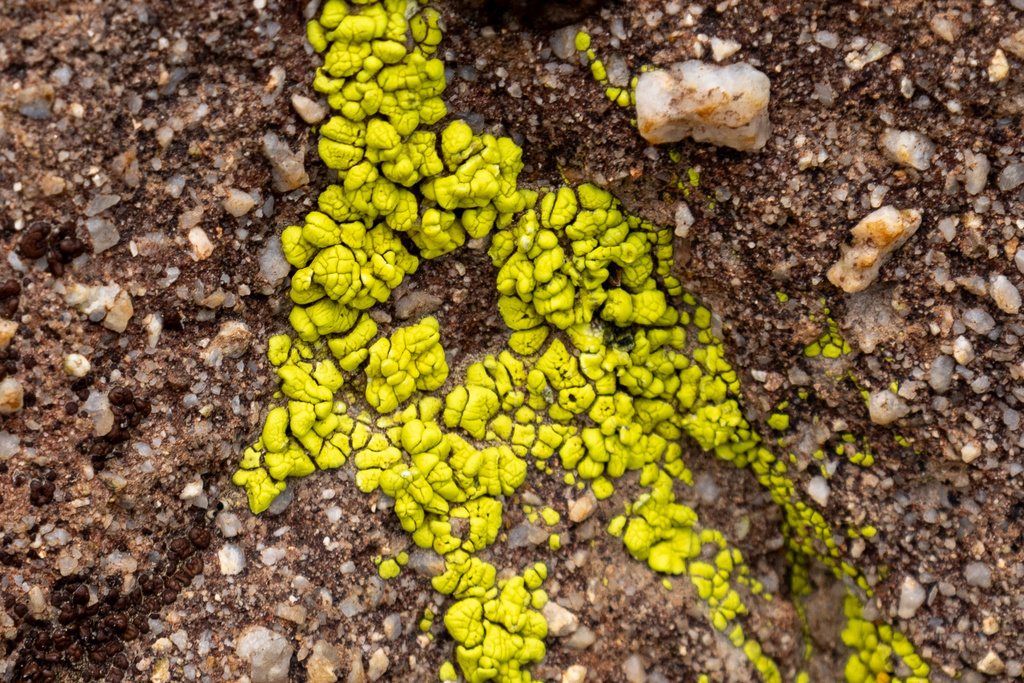
Yellow Cobblestone Lichen
Acarospora socialis
Fungusstrong against amphibians, reptiles
Common
Mycelium
While active with another fungus in play, it regains 5 HP at the start of your turn (8 with two others).
41

27
Yellow Cobblestone Lichen
Acarospora socialis
Fungusstrong against amphibians, reptiles
Common
While active with another fungus in play, it regains 5 HP at the start of your turn (8 with two others).
Acarospora socialis
Photo: © Roberto Daniel Avila (original photo) · CC BY 4.0 (licence text) · cropped
Strong against: it deals 20% more damage to them. Weak against: these types deal 20% more damage to it.
Acarospora socialis (bright cobblestone lichen) is a usually bright yellow areolate to squamulose crustose lichen in the family Acarosporaceae that grows up to 10 cm wide, mostly on rock in western North America. It is among the most common lichens in the deserts of Arizona and southern California. It grows on sandstone, intrusive and extrusive igneous rock such as granitics, in all kinds of exposures to sunlight, including vertical rock walls. It is found in North America, including areas of the Mojave Desert and Sonoran Desert region, to Baja California Sur. It is the most common yellow member of its genus in southwestern North America. It sometimes, but rarely, grows on other soil crusts. It is a pioneer species.
It is variable in its growth pattern. Areoles can be angular to round, sometimes forming lobes. They can be contiguous or scattered. Color is variable - bleached white, green-yellow, and other shades of yellow. It has a lower surface when squamulose, but without a lower cortex. With age, it forms stipes. Each squamule has ( usually one ) angular apothecia which may be up to 1.5 mm in diameter and 0.8 mm in thickness. Two apothecia may merge, leaving a peninsula (umbo) of thalline tissue through the disc. Apothecia may have lecanorine margins. Apothecia have a flat to concave mostly brown or reddish brown, concave disc.
Lichen spot tests are all negative. It is UV+ orange. Secondary metabolites include rhizocarpic acid, and sometimes trace amounts of epanorin.
Abridged excerpt from the Wikipedia article Acarospora socialis, by its authors, under the CC BY-SA 4.0 licence.
No global status on the IUCN Red List: that’s what makes this card Common.
Every Common card has 100 points, shared between HP, ATK and DEF:
How they’re shared out:

 DEF 27