 …
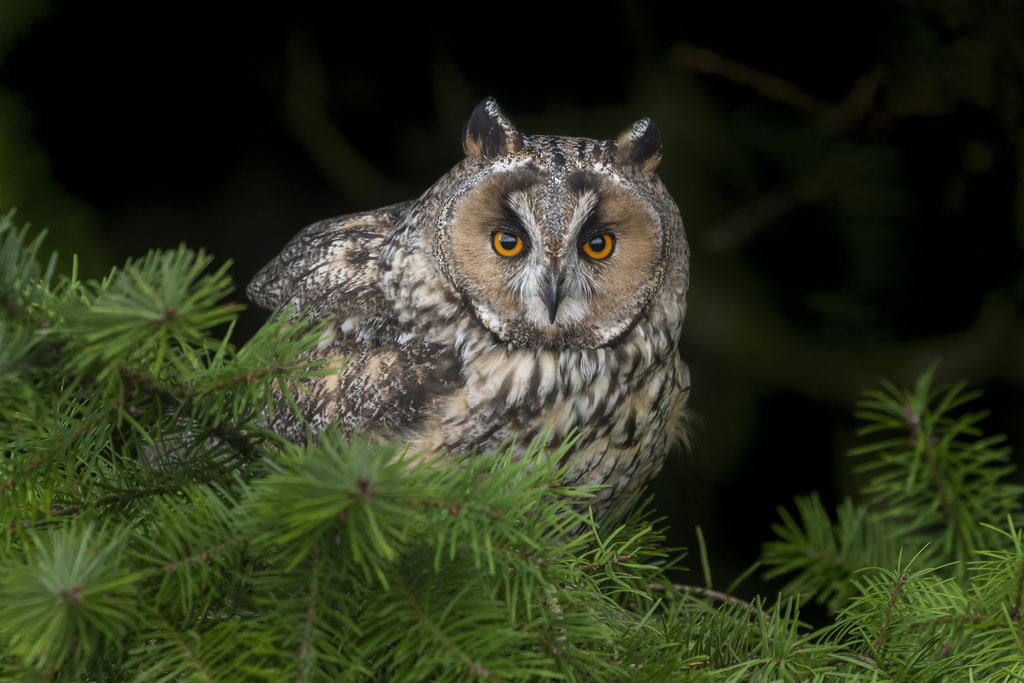
Long-eared Owl
Asio otus
Birdstrong against fish, reptiles
Common
Swoop
While active with another bird in play, it hits 6 harder on its first attack after entering play (12 with two others).
29

33
Long-eared Owl
Asio otus
Birdstrong against fish, reptiles
Common
While active with another bird in play, it hits 6 harder on its first attack after entering play (12 with two others).
Asio otus
Photo: © caroline legg (original photo) · CC BY 4.0 (licence text) · cropped
Strong against: it deals 20% more damage to them. Weak against: these types deal 20% more damage to it.
The long-eared owl (Asio otus), also known as the northern long-eared owl or informally as the lesser horned owl or cat owl, is a medium-sized typical owl with an extensive range. The genus name, Asio, is Latin for "horned owl", and the specific epithet, otus, is derived from Greek and refers to a small eared owl. It breeds in Europe and the Palearctic, as well as in North America.
This owl prefers semi-open habitats, particularly woodland edge, as they to roost and nest within dense stands of wood but prefer to hunt over open ground. The long-eared owl primarily hunts small rodents, especially voles, but during population cycles of their regular prey, or in arid, insular, or urbanized habitats, it takes diverse prey including birds and insects. The long-eared owl utilizes nests built by other animals, in particular by corvids. Breeding success in this species is correlated with prey populations and predation risks. Unlike many owls, long-eared owls are not strongly territorial or sedentary. They are partially migratory or nomadic. Another characteristic of this species is its partiality for regular roosts shared by a number of long-eared owls at once. The long-eared owl is one of the most widely distributed and most numerous owl species in the world, and due to its very broad range and numbers it is considered a least concern species by the IUCN. Nonetheless, strong declines have been detected for this owl in several parts of its range.
Excerpt from the Wikipedia article Long-eared owl, by its authors, under the CC BY-SA 4.0 licence.
Least Concern on the IUCN Red List: that’s what makes this card Common.
Every Common card has 100 points, shared between HP, ATK and DEF:
How they’re shared out:

 DEF 33