 …
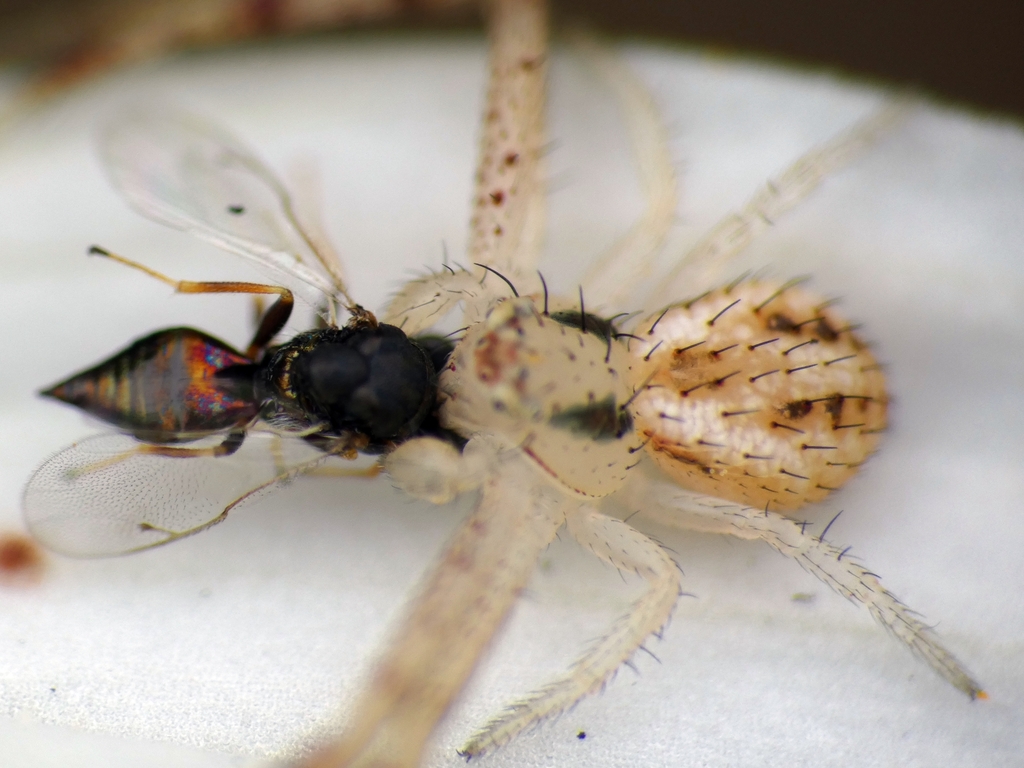
Swift Crab Spider
Mecaphesa celer
Arachnidstrong against insects, birds
Common
Venom
While active with another arachnid in play, its target loses 4 HP at the start of each of its turns, as long as it stays active (7 with two others).
40

28
Swift Crab Spider
Mecaphesa celer
Arachnidstrong against insects, birds
Common
While active with another arachnid in play, its target loses 4 HP at the start of each of its turns, as long as it stays active (7 with two others).
Mecaphesa celer
Photo: © Kai Squires (original photo) · CC BY 4.0 (licence text) · cropped
Strong against: it deals 20% more damage to them. Weak against: these types deal 20% more damage to it.
Mecaphesa celer, known generally as the swift crab spider, is a species of crab spider in the family Thomisidae. Its range is quite large, and it is found throughout much of North and Central America.
M. celer are sit-and-wait predators who hide out on the flowers and upper stalks of plants, waiting for prey to pass by. As a variety of crab spider, they have characteristically long first two pairs of legs which they use to grab prey. M. celer spin webs only for creating egg sacs and as part of mating, not for hunting.
The spider is a notable example of a species that displays sexual size dimorphism (SSD), a phenomenon in which one sex is significantly larger than the other. In the case of M. celer, females are dramatically larger than males, sometimes over twice their size, making the species a case of extreme sexual size dimorphism.
M. celer also displays sexual cannibalism, as the females have been observed to eat their male mates if the males are still in proximity of the females after copulation.
Like other spiders within the Thomisidae family, M. celer are an important pest control species for agriculture since they hunt at the upper parts of crop plants where the grains or other harvested products grow. They thereby prey upon and protect agricultural products from potential pests like aphids.
Abridged excerpt from the Wikipedia article Mecaphesa celer, by its authors, under the CC BY-SA 4.0 licence.
No global status on the IUCN Red List: that’s what makes this card Common.
Every Common card has 100 points, shared between HP, ATK and DEF:
How they’re shared out:

 DEF 28