
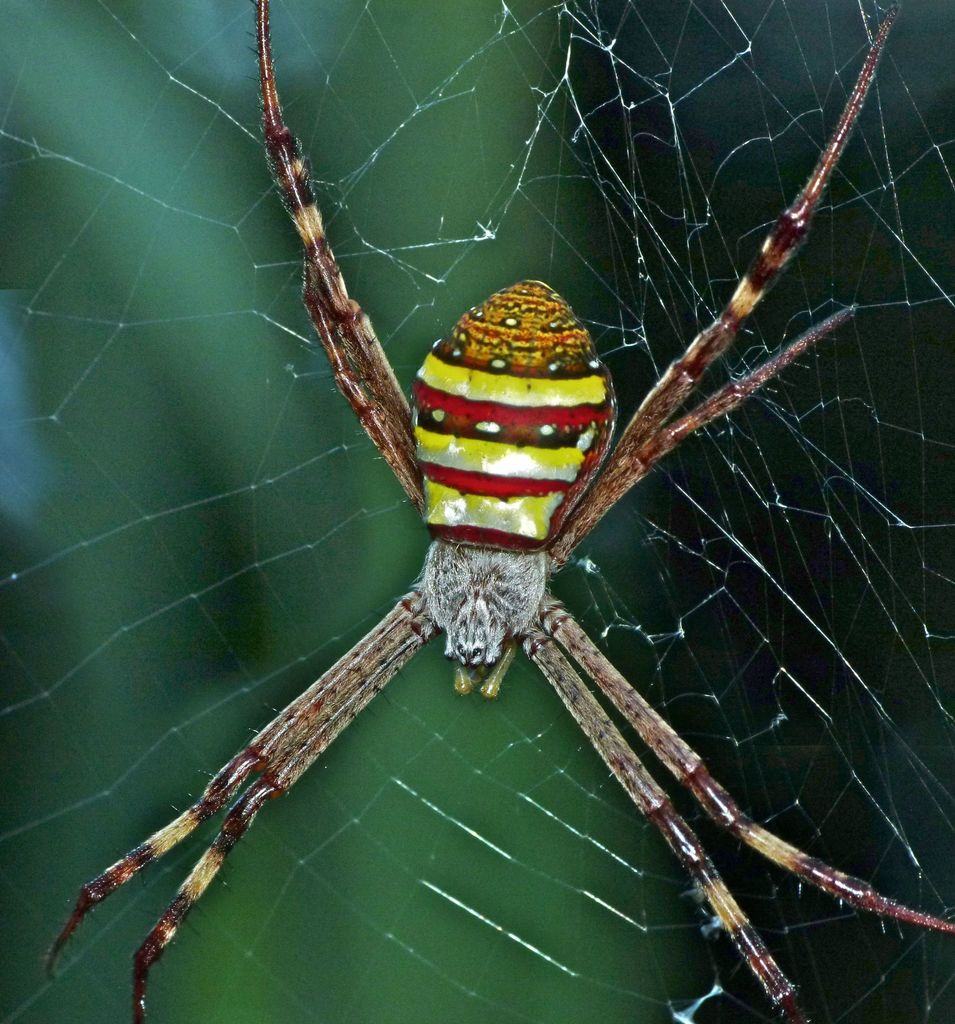
Saint Andrew's Cross Spider
Argiope keyserlingi
Arachnidstrong against insects, birds
Common
While active with another arachnid in play, its target loses 4 HP at the start of each of its turns, as long as it stays active (7 with two others).

Saint Andrew's Cross Spider
Argiope keyserlingi
Arachnidstrong against insects, birds
Common
While active with another arachnid in play, its target loses 4 HP at the start of each of its turns, as long as it stays active (7 with two others).
Argiope keyserlingi
Photo: © Steve Kerr (original photo) · CC BY 4.0 (licence text) · cropped
Strong against: it deals 20% more damage to them. Weak against: these types deal 20% more damage to it.
Argiope keyserlingi is a species of orb-web spider found on the east coast of Australia, from Victoria to northern Queensland. It is very similar in appearance to a closely related north Queensland species, Argiope aetherea. A. keyserlingi is commonly found in large populations in suburban parks and gardens, particularly among the leaves of Lomandra longifolia. Like many species of orb-web spiders, A. keyserlingi shows considerable sexual dimorphism, with the females being many times larger than the males. Mature females can be seen during the summer, and seeing multiple males on the web of one female is not uncommon.
A. keyserlingi is commonly known as the St. Andrew's cross spider, due to the construction of bands of silk forming the arms of an X-shaped cross, similar to the one upon which St. Andrew is traditionally said to have been crucified. Juveniles of this species sometimes build a spiral-shaped pattern of silk. Referred to as web decorations or stabilimenta, these bands are thought to increase the species' prey capture rate, but as in other species, they have been found to protect the spider against predators.
A. keyserlingi is an important model species in studies of spider ecology and behaviour. Using this species, scientists have investigated sperm competition, sexual size dimorphism, cryptic female choice, the role of pheromones in mating behaviour, and the function and evolution of web decorations.
Its main predators in Sydney are mantids and birds.
Abridged excerpt from the Wikipedia article Argiope keyserlingi, by its authors, under the CC BY-SA 4.0 licence.
No global status on the IUCN Red List: that’s what makes this card Common.
Every Common card has 100 points, shared between HP, ATK and DEF:
How they’re shared out:

