 …
Blue Wanderer
Tirumala hamata
Insectstrong against fungi, fish
Common
Swarm
While active with another insect in play, each of its attacks also hits the opposing bench for 10, without knocking them out (20 with two others).
40

38
Blue Wanderer
Tirumala hamata
Insectstrong against fungi, fish
Common
While active with another insect in play, each of its attacks also hits the opposing bench for 10, without knocking them out (20 with two others).
Tirumala hamata
Photo: © Marilyn Connell (original photo) · CC BY 4.0 (licence text) · cropped
Strong against: it deals 20% more damage to them. Weak against: these types deal 20% more damage to it.
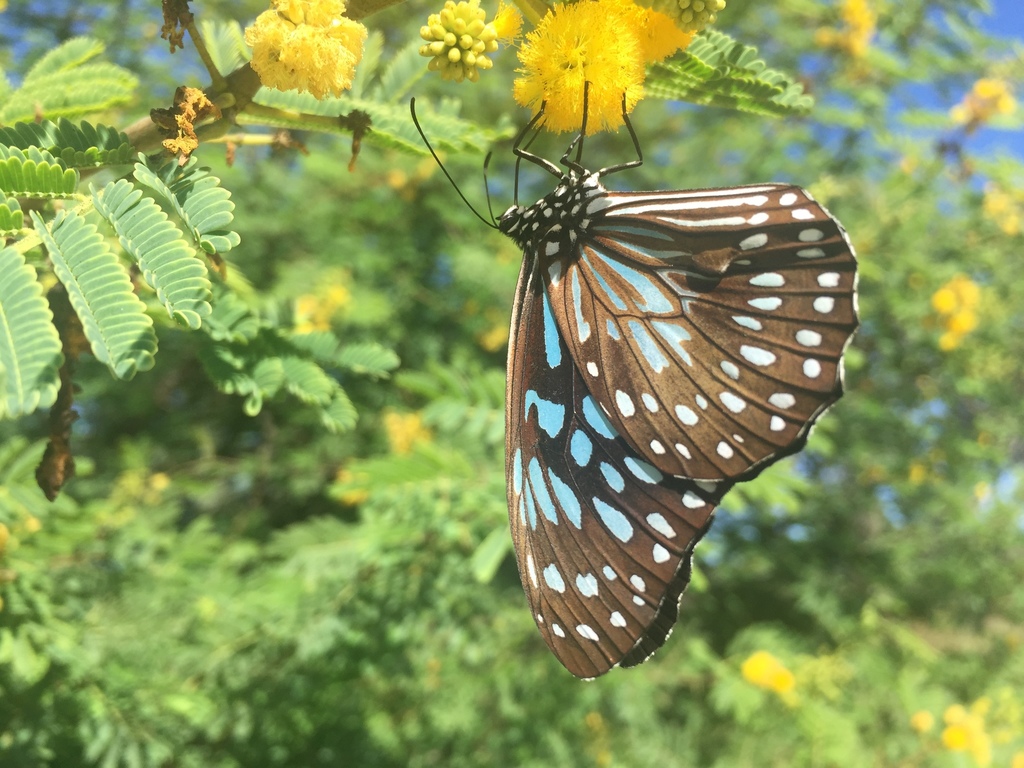
Tirumala hamata, the dark tiger, is a butterfly of the family Nymphalidae. It is distributed from the Philippines to Australia and Pacific oceanic islands such as Samoa. In Australia, the butterflies perform mass migrations to the south in some years. In April 1995, the butterfly made a rare migratory journey to New Zealand, coinciding with the appearance of Hypolimnas bolina on the islands.
The wingspan is about 70 mm. Adults have black wings with blue spots. They are grey with black bands between segments and orange lateral lines and a black head with white markings. Adults have been observed scratching the leaves of Heliotropium amplexicaule and Parsonsia straminea, possibly to suck out moisture, or to obtain pyrrolizidine alkaloids for pheromone production and/or chemical defense.
The larvae feed on a wide range of plants including Parsonsia (including Parsonsia straminea and Parsonsia velutina), Heterostemma papuana, Heterostemma acuminatum, Hoya australis, Leichhardtia, Marsdenia (including Marsdenia velutina), Secanome carnosum, Secamone elliptica, Vincetoxicum (syn. Tylophora), Cryptostegia grandiflora, Cynanchum carnosum, and Cynanchum leptolepis.
Excerpt from the Wikipedia article Tirumala hamata, by its authors, under the CC BY-SA 4.0 licence.
No global status on the IUCN Red List: that’s what makes this card Common.
Every Common card has 100 points, shared between HP, ATK and DEF:
How they’re shared out:

 DEF 38