 …
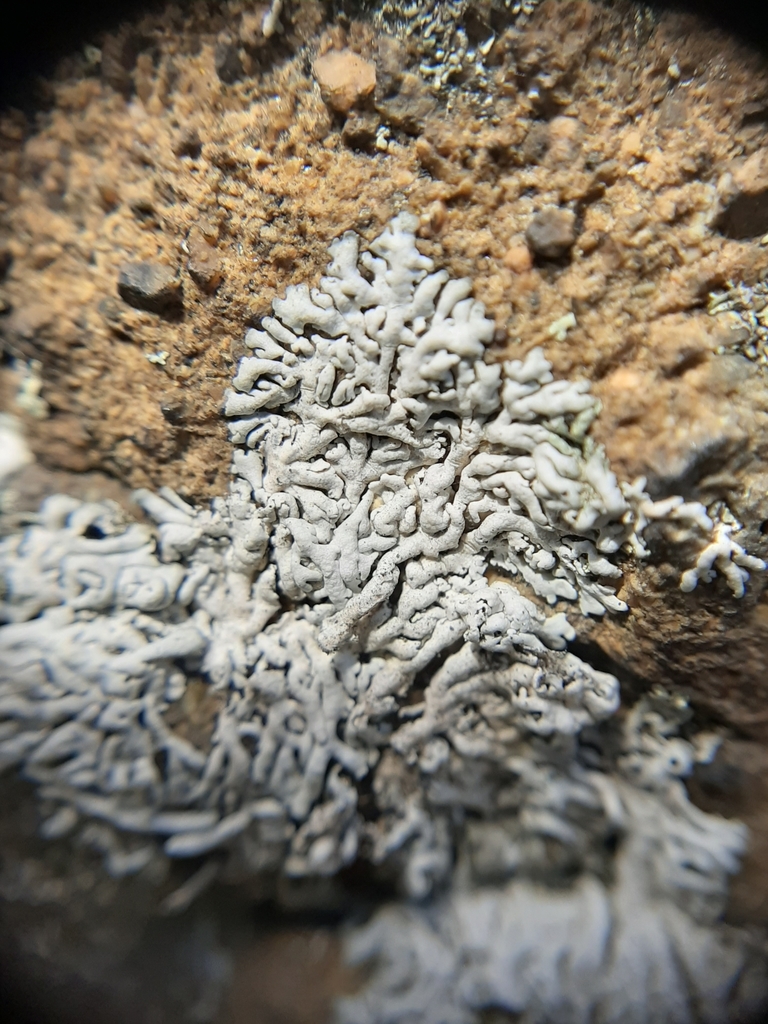
Blue-gray Rosette Lichen
Physcia caesia
Fungusstrong against amphibians, reptiles
Common
Mycelium
While active with another fungus in play, it regains 5 HP at the start of your turn (8 with two others).
40

29
Blue-gray Rosette Lichen
Physcia caesia
Fungusstrong against amphibians, reptiles
Common
While active with another fungus in play, it regains 5 HP at the start of your turn (8 with two others).
Physcia caesia
Photo: © Colin Meurk (original photo) · CC BY-SA 4.0 (licence text) · cropped
Strong against: it deals 20% more damage to them. Weak against: these types deal 20% more damage to it.
Physcia caesia, known colloquially as blue-gray rosette lichen and powder-back lichen, is a species of foliose lichenized fungus. First described by Georg Franz Hoffmann in 1784, it is common across much of Europe, North America and New Zealand, and more patchily distributed in South America, Asia, Australia and Antarctica. There are 2 subspecies: P. c. caesia and P. c. ventosa, as well as a number of distinct forms and varieties. Molecular studies suggest that the species as currently defined may be polyphyletic. It is typically pale gray shading to darker gray in the center (though some forms are considerably darker), and grows in a small rosette, usually some 2–3 cm (0.79–1.18 in) across at maturity. It only rarely has apothecia, instead reproducing most often vegetatively via soredia, which are piled in round blue-gray mounds across the thallus's upper surface. It grows most often on rock—principally calcareous, but also basaltic and siliceous—and also occurs on bone, bark and soil. It is nitrophilic and is particularly common on substrates where birds perch.
Abridged excerpt from the Wikipedia article Physcia caesia, by its authors, under the CC BY-SA 4.0 licence.
No global status on the IUCN Red List: that’s what makes this card Common.
Every Common card has 100 points, shared between HP, ATK and DEF:
How they’re shared out:

 DEF 29