 …
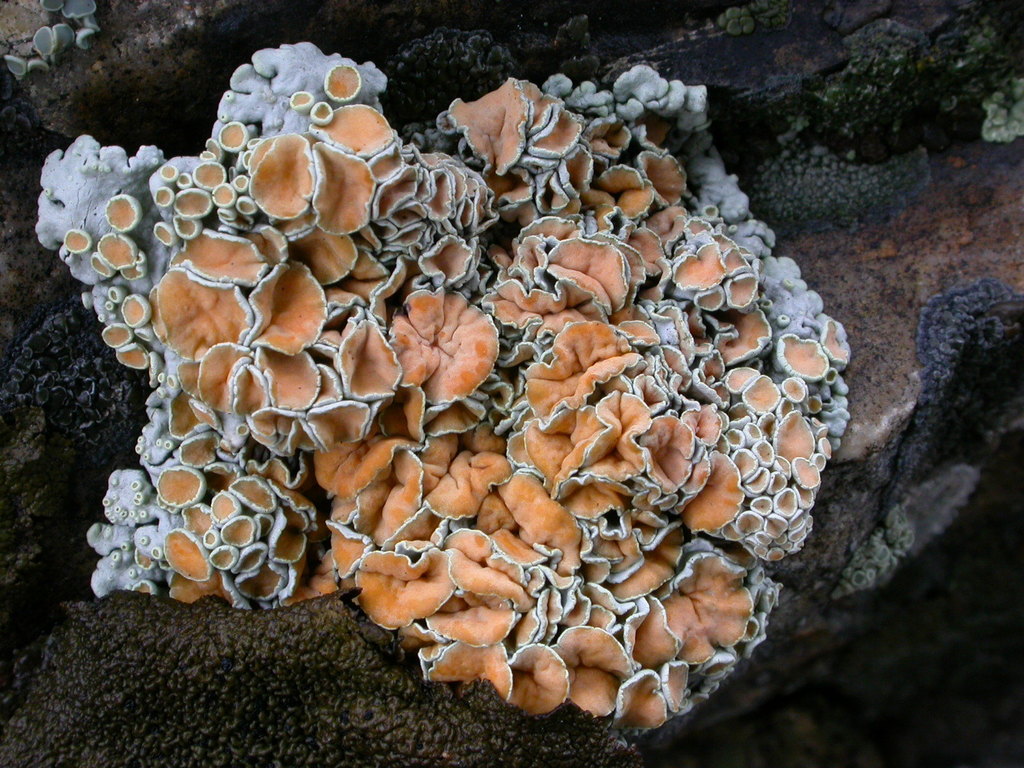
Orange Rock Posy
Rhizoplaca chrysoleuca
Fungusstrong against amphibians, reptiles
Common
Mycelium
While active with another fungus in play, it regains 5 HP at the start of your turn (8 with two others).
40

28
Orange Rock Posy
Rhizoplaca chrysoleuca
Fungusstrong against amphibians, reptiles
Common
While active with another fungus in play, it regains 5 HP at the start of your turn (8 with two others).
Rhizoplaca chrysoleuca
Photo: © anonymous (original photo) · CC BY-SA 4.0 (licence text) · cropped
Strong against: it deals 20% more damage to them. Weak against: these types deal 20% more damage to it.
Rhizoplaca chrysoleuca (orange rim lichen, rock-posy lichen, rockbright) is a pale yellowish-green to gray-green umbilicate foiliose lichen in the Lecanoraceae (rim lichen) family. It was first described in 1791 by English botanist Sir James Edward Smith as Lichen chrysoleucus; Friedrich Wilhelm Zopf transferred it to the genus Rhizoplaca in 1905.
The single-leaf (monophyllous) umbilicate thallus can be 2–3.5 cm in width, with deep lobes. The thallus is relatively thick and lumpy with warts and lobules. The fruiting structures (apothecia have lightly pruinose, burnt-orange to tan discs rimmed, with a contrasting rim of pale greenish thallus-like tissue making them easy to identify. Apothecia are 0.8–2.5 mm diameter, and often numerous and crowded into each other.
It grows in Eurasia and western North America. In the Sonoran Desert region it grows at elevations from 1,200 to 3,200 metres (3,900 to 10,500 ft). It prefers siliceous rock, granite, schist, quartz, mica, and basalt, but is also found on sandstone and less commonly on calcareous rock. It grows from the high desert to the alpine zone. It is often nitrophilous, preferring dropping areas under bird perches. It is common on rock in inland arid mountain and desert habitats in California.
Lichen spot tests are K+ yellow or K−, KC+ yellow-orange, C−, and P− on the cortex, and K−, KC+ red or KC−, C−, and P+ yellow or P− on the medulla.
Excerpt from the Wikipedia article Rhizoplaca chrysoleuca, by its authors, under the CC BY-SA 4.0 licence.
No global status on the IUCN Red List: that’s what makes this card Common.
Every Common card has 100 points, shared between HP, ATK and DEF:
How they’re shared out:

 DEF 28