 …
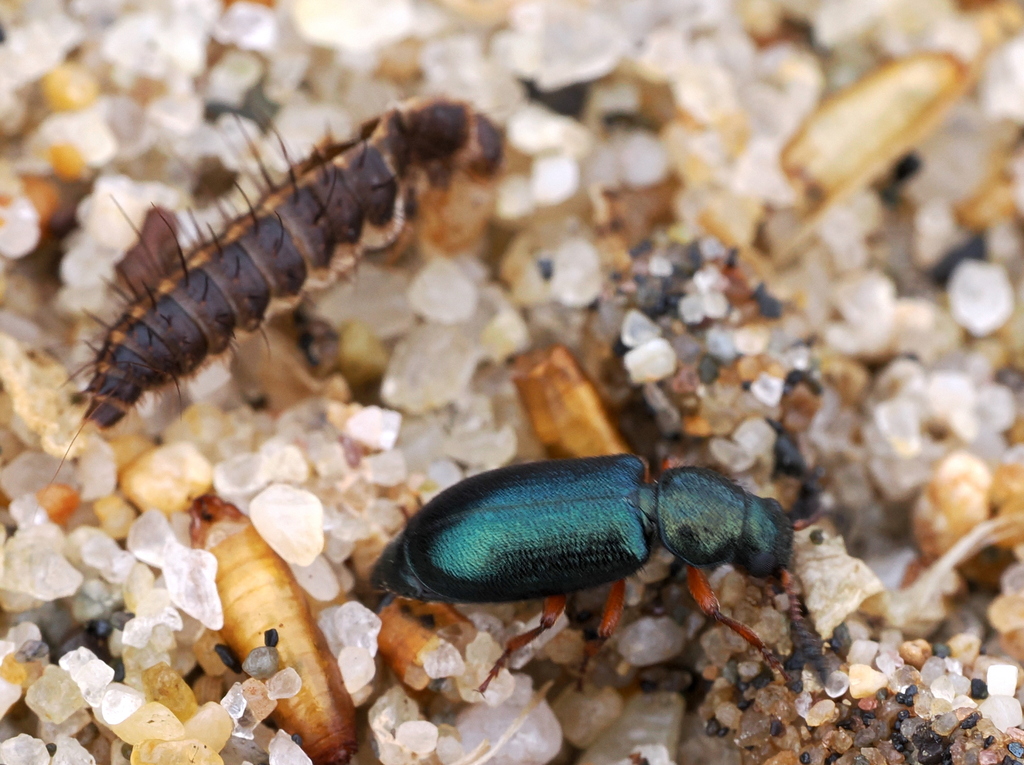
Red-legged Ham Beetle
Necrobia rufipes
Insectstrong against fungi, fish
Common
Swarm
While active with another insect in play, each of its attacks also hits the opposing bench for 10, without knocking them out (20 with two others).
28

40
Red-legged Ham Beetle
Necrobia rufipes
Insectstrong against fungi, fish
Common
While active with another insect in play, each of its attacks also hits the opposing bench for 10, without knocking them out (20 with two others).
Necrobia rufipes
Photo: © Henrik Kibak (original photo) · CC BY 4.0 (licence text) · cropped
Strong against: it deals 20% more damage to them. Weak against: these types deal 20% more damage to it.
Necrobia rufipes, the red-legged ham beetle, is a species of predatory beetle, in the family Cleridae, with a cosmopolitan distribution, first described by Charles De Geer in 1775.
The adult beetles are 3.5–7.0 millimetres (0.1–0.3 in) long, convex, straight sided, and the surface has indentations called punctures.
They are shiny metallic green or greenish blue. The legs and antennae are red (dark clubs). They feed on the meat-infesting larvae of Calliphora or blow flies, Dermestidae and Piophilidae. The adults are surface feeders; the larvae bore into dry or smoked meats and do most damage. The red-legged ham beetle also attacks bones, hides, copra, dried egg, cheese, guano, bone meal, dried figs, and palm nut kernels. Although refrigeration has reduced the impact of the beetle on meats, they are a significant destructive pest of dried and salt fish including herring. It was well documented as a threat to agriculture by 1925.
Necrobia rufipes has been recorded in Egyptian mummies and were once known as Necrobia mumiarum (Rev. F.W. Hope, 1834).
Two related species are Necrobia violacea which has all-dark legs and antennae, and Necrobia ruficollis, which has light-coloured bases of the elytra (shoulders). Although similar, neither are as destructive as N. rufipes. This species should not be confused with its cousin, Korynetes caeruleus, another steely-blue beetle in the family Cleridae. Both species have a significance in forensic entomology but for different reasons.
Excerpt from the Wikipedia article Necrobia rufipes, by its authors, under the CC BY-SA 4.0 licence.
No global status on the IUCN Red List: that’s what makes this card Common.
Every Common card has 100 points, shared between HP, ATK and DEF:
How they’re shared out:

 DEF 40