 …
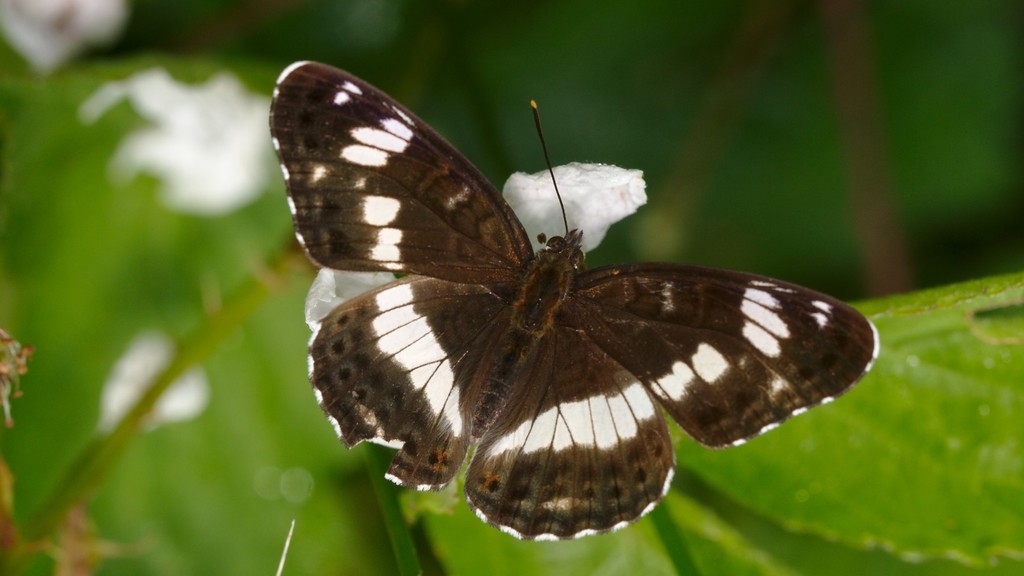
Eurasian White Admiral
Limenitis camilla
Insectstrong against fungi, fish
Common
Swarm
While active with another insect in play, each of its attacks also hits the opposing bench for 10, without knocking them out (20 with two others).
40

38
Eurasian White Admiral
Limenitis camilla
Insectstrong against fungi, fish
Common
While active with another insect in play, each of its attacks also hits the opposing bench for 10, without knocking them out (20 with two others).
Limenitis camilla
Photo: Kees (original photo) · CC0 (licence text) · cropped
Strong against: it deals 20% more damage to them. Weak against: these types deal 20% more damage to it.
Limenitis camilla, the (Eurasian) white admiral, is a butterfly of the family Nymphalidae. It is found in woodland throughout southern Britain and much of temperate Eurasia and the Palearctic, extending as far east as Japan.
Adult white admirals have dark wings with white bands. The contrasting colours help to break up the outline of the wing, camouflaging it from predators. They have a wingspan of approximately 60–65 mm and have a distinctive, elegant flight consisting of short periods of wing beats, followed by long glides.
The white admiral is typically found in shady woodland areas, where it feeds on bramble blossom and honeydew and the female will lay its eggs singly on wisps of honeysuckle growing in dense woodland. The caterpillars are green with red-brown hairs and are camouflaged on a leaf by a mixture of their own droppings and silk. As autumn approaches it will form a tent-like structure made of leaf tissue known as a hibernaculum which it then secures to the stem with silk before hibernating. The caterpillar will then awaken the following spring and after a brief spell of feeding will moult, revealing a spiny green skin. It will then pupate during the summer, forming a green and gold chrysalis. After approximately two weeks the adult will emerge.
Larvae feed on Lonicera (L. japonica, L. xylosteum, L. tatarica, L. maackii, L. gibbiflora) and Weigela horstensis.
Excerpt from the Wikipedia article Limenitis camilla, by its authors, under the CC BY-SA 4.0 licence.
No global status on the IUCN Red List: that’s what makes this card Common.
Every Common card has 100 points, shared between HP, ATK and DEF:
How they’re shared out:

 DEF 38