
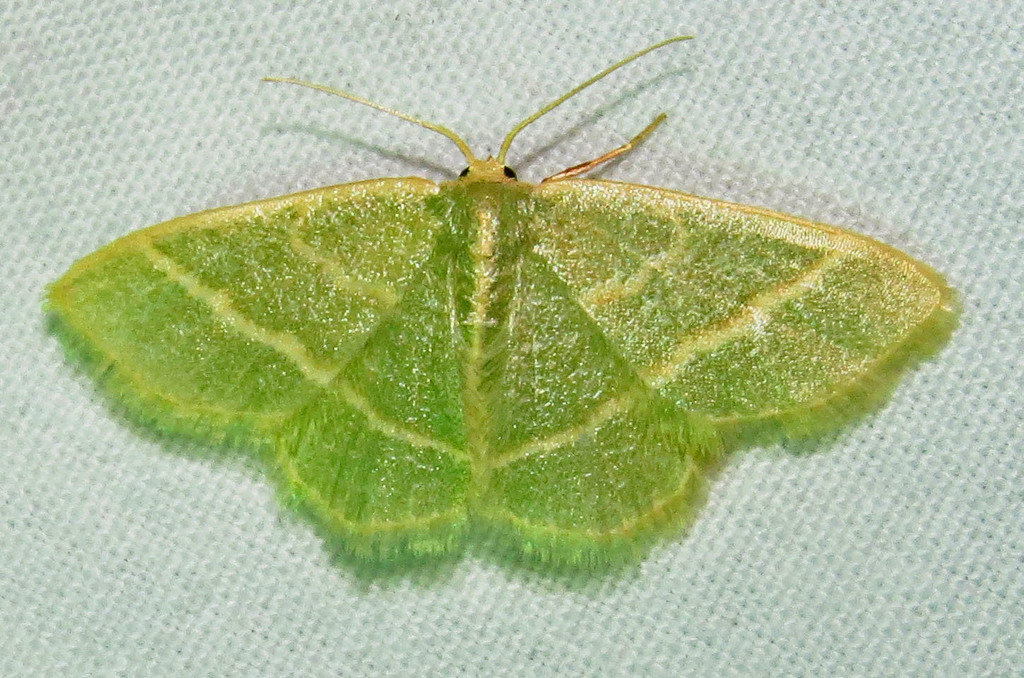
Blackberry Looper Moth
Chlorochlamys chloroleucaria
Insectstrong against fungi, fish
Common
While active with another insect in play, each of its attacks also hits the opposing bench for 10, without knocking them out (20 with two others).

Blackberry Looper Moth
Chlorochlamys chloroleucaria
Insectstrong against fungi, fish
Common
While active with another insect in play, each of its attacks also hits the opposing bench for 10, without knocking them out (20 with two others).
Chlorochlamys chloroleucaria
Photo: © David Dodd (original photo) · CC BY 4.0 (licence text) · cropped
Strong against: it deals 20% more damage to them. Weak against: these types deal 20% more damage to it.
Chlorochlamys chloroleucaria, the blackberry looper, is a moth of the family Geometridae. It is found from Nova Scotia to Florida, west in Canada to Manitoba, west in the United States to the Rocky Mountains, and south into Mexico.
It is also listed as occurring in Great Britain. This is based on a single individual held in the BMNH and originating from the early 19th century.
The wingspan is 14–23 mm. Adults are on wing from April to November in the south and from May to September in the north. There are at least two generations per year.
The larvae feed on the fruit of blackberries and petals of various composite flowers. Recorded food plants include Achillea millefolium, Ambrosia, Aster, Chrysanthemum leucanthemum, Eupatorium perfoliatum, Gutierrezia dracunculoides, Gutierrezia texana, Helenium autumnale, Helianthus, Parthenium hysterophorus, Rudbeckia hirta, Solidago, Vernonia, Zinnia, Dianthus, Prunus pennsylvanica, Rubus, Ceanothus, Myrica asplenifolia and Apocynum androsaemifolium.
Excerpt from the Wikipedia article Chlorochlamys chloroleucaria, by its authors, under the CC BY-SA 4.0 licence.
No global status on the IUCN Red List: that’s what makes this card Common.
Every Common card has 100 points, shared between HP, ATK and DEF:
How they’re shared out:

