 …
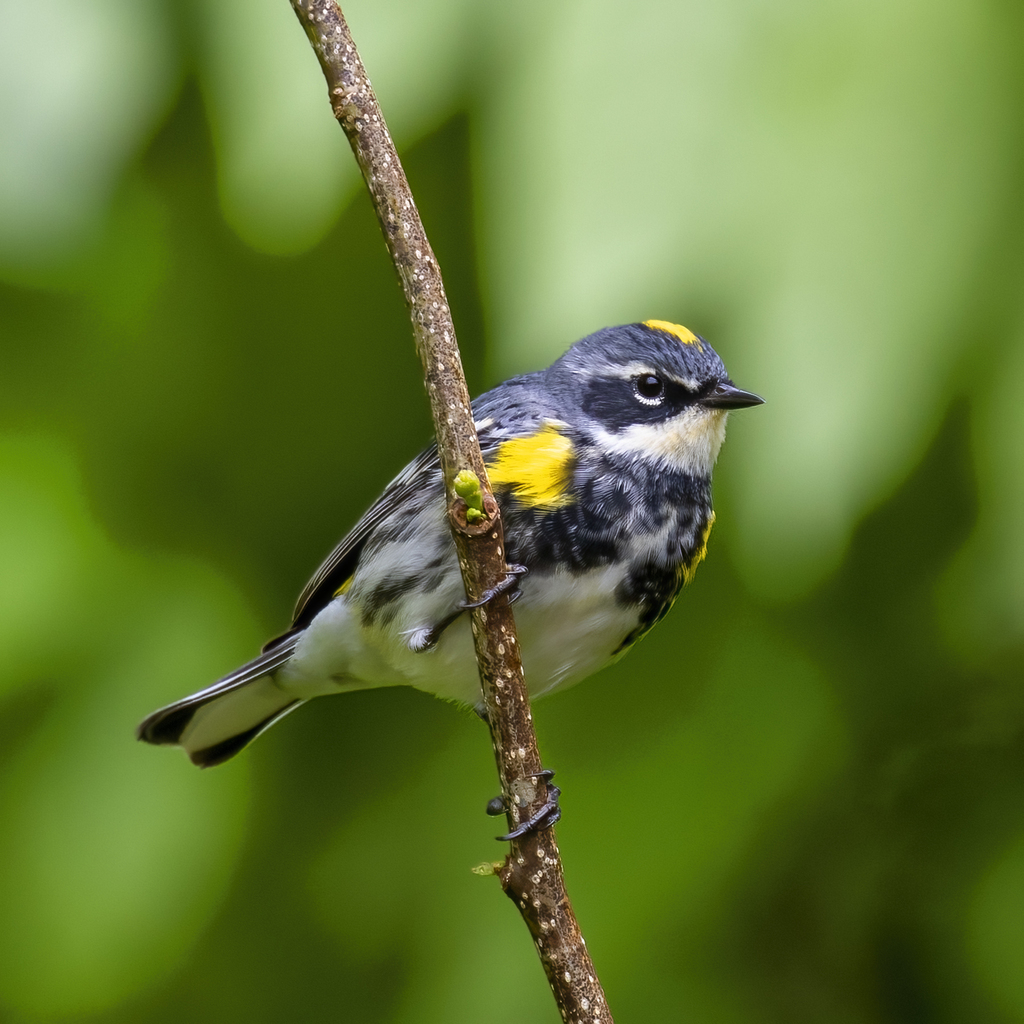
Yellow-rumped Warbler
Setophaga coronata
Birdstrong against fish, reptiles
Common
Swoop
While active with another bird in play, it hits 6 harder on its first attack after entering play (12 with two others).
36

37
Yellow-rumped Warbler
Setophaga coronata
Birdstrong against fish, reptiles
Common
While active with another bird in play, it hits 6 harder on its first attack after entering play (12 with two others).
Setophaga coronata
Photo: © Dan Vickers (original photo) · CC BY 4.0 (licence text) · cropped
Strong against: it deals 20% more damage to them. Weak against: these types deal 20% more damage to it.
The yellow-rumped warbler (Setophaga coronata) is a North American bird species that can be commonly observed all across the continent. Its extensive range connects both the Pacific and Atlantic coasts of the U.S. as well as Canada and Central America, with the population concentrated in the continent's northern reaches during the breeding season and migrating southwards to southern North and Central America in the winter. It generally prefers coniferous forests or mixed coniferous-deciduous forests as its breeding habitat, while during the winter it can be found inhabiting more open areas such as shrublands that offer food resources. The yellow-rumped warbler is primarily insectivorous, though the species eats fruit such as juniper berries, especially in winter.
The species combines four closely related forms: the eastern myrtle warbler (spp. coronata); its western counterpart, Audubon's warbler (spp. group auduboni); the northwest Mexican black-fronted warbler (spp. nigrifrons); and the Guatemalan Goldman's warbler (spp. goldmani). All subspecies of the yellow-rumped warbler are characterized by the yellow rump as its name implies, while intra-group and inter-group variations in appearance exist in spite of many similarities. The myrtle and Audubon's groups, as two major subspecies, are distinguished by noticeable features such as differing throat colorations.
Excerpt from the Wikipedia article Yellow-rumped warbler, by its authors, under the CC BY-SA 4.0 licence.
Least Concern on the IUCN Red List: that’s what makes this card Common.
Every Common card has 100 points, shared between HP, ATK and DEF:
How they’re shared out:

 DEF 37