 …
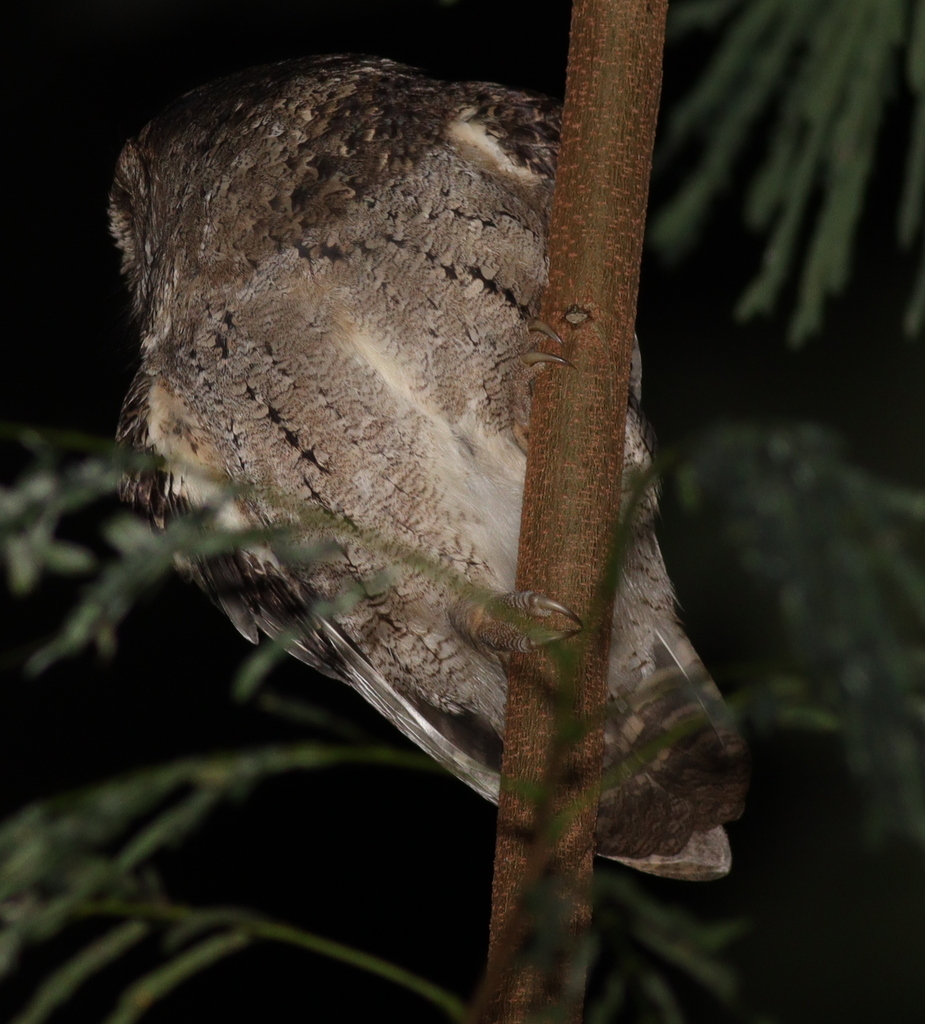
Collared Scops-Owl
Otus lettia
Birdstrong against fish, reptiles
Common
Swoop
While active with another bird in play, it hits 6 harder on its first attack after entering play (12 with two others).
28

35
Collared Scops-Owl
Otus lettia
Birdstrong against fish, reptiles
Common
While active with another bird in play, it hits 6 harder on its first attack after entering play (12 with two others).
Otus lettia
Photo: © Jan Ebr & Ivana Ebrová (original photo) · CC BY 4.0 (licence text) · cropped
Strong against: it deals 20% more damage to them. Weak against: these types deal 20% more damage to it.
The collared scops owl (Otus lettia) is an owl which is a resident breeder in south Asia from northern Pakistan, northern India, Nepal, Bangladesh, the Himalayas east to southern China, and Taiwan. It is partially migratory, with some birds wintering in India, Sri Lanka and Malaysia. This species was formerly considered to be included within what is now separated as the Indian scops owl (O. bakkamoena).
This species is a part of the larger grouping of owls known as typical owls, Strigidae, which contains most species of owl. The other grouping is the barn owls, Tytonidae.
The collared scops owl is a common breeding bird in forests and other well-wooded areas. It nests in tree hollows, laying 3-5 eggs.
The collared scops owl is a small (23–25 cm) owl, although it is the largest of the scops owls. Like other scops owls, it has small head tufts, or ears. The upperparts are grey or brown, depending on the subspecies, with faint buff spotting. The underparts are buff with fine darker streaking.
The facial disc is whitish or buff, and the eyes are orange or brown. There is a buff neckband. Sexes are similar. The flight is deeply undulating.
This species is nocturnal but it can often be located by the small birds that mob it while it is roosting in a tree. It feeds mainly on insects. The call is a quiet goog gook.
Abridged excerpt from the Wikipedia article Collared scops owl, by its authors, under the CC BY-SA 4.0 licence.
Least Concern on the IUCN Red List: that’s what makes this card Common.
Every Common card has 100 points, shared between HP, ATK and DEF:
How they’re shared out:

 DEF 35