 …
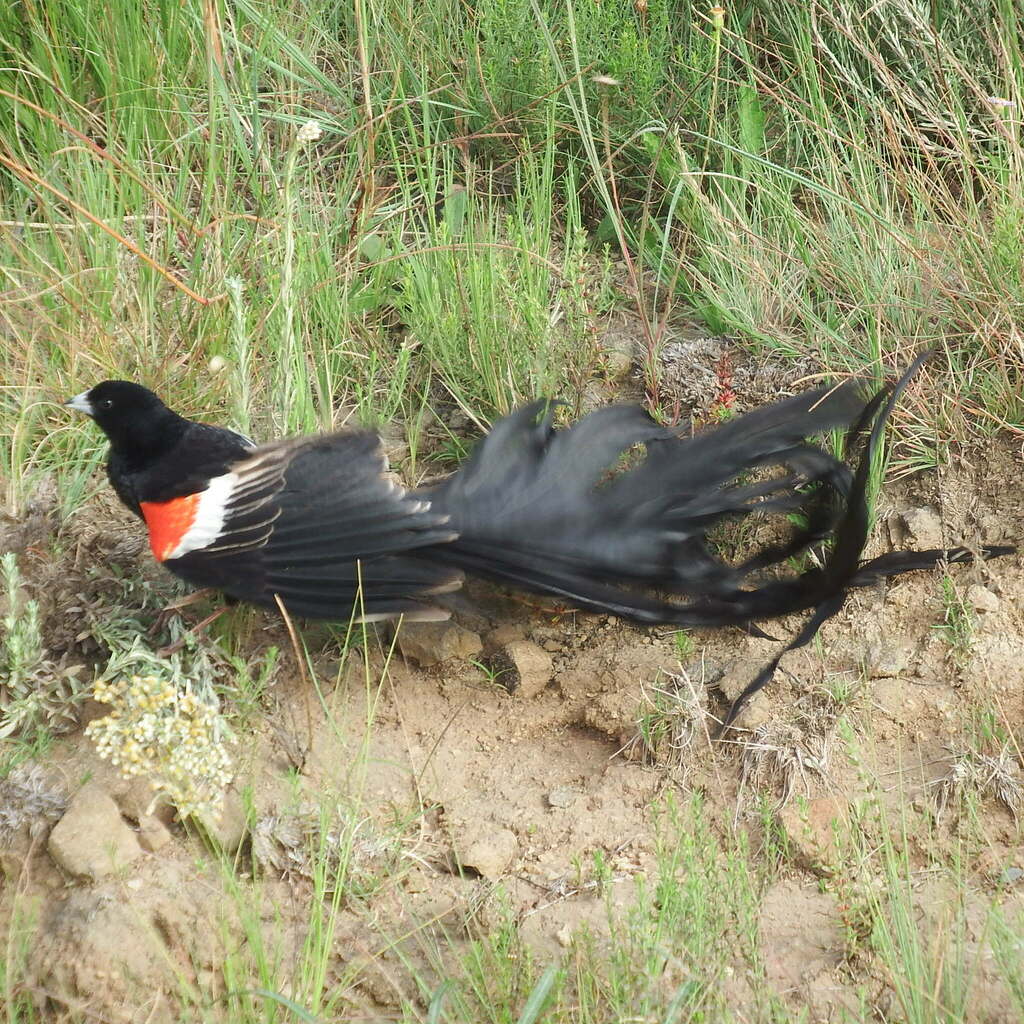
Long-tailed Widowbird
Euplectes progne
Birdstrong against fish, reptiles
Common
Swoop
While active with another bird in play, it hits 6 harder on its first attack after entering play (12 with two others).
30

38
Long-tailed Widowbird
Euplectes progne
Birdstrong against fish, reptiles
Common
While active with another bird in play, it hits 6 harder on its first attack after entering play (12 with two others).
Euplectes progne
Photo: © Margaret Burger (original photo) · CC BY-SA 4.0 (licence text) · cropped
Strong against: it deals 20% more damage to them. Weak against: these types deal 20% more damage to it.
The long-tailed widowbird (Euplectes progne) is a species of bird in the weaver family Ploceidae. The species is found in Angola, Botswana, the Democratic Republic of the Congo, Kenya, Lesotho, South Africa, Eswatini, and Zambia. The long-tailed widowbird is a medium-sized bird and one of the most common in the territories it inhabits. Adult breeding males are almost entirely black with orange and white shoulders ("epaulets"), long, wide tails, and a bluish white bill. Females are rather inconspicuous, their feathers streaked tawny and black with pale patches on the chest, breast and back, narrow tail feathers, and horn-coloured bills.
When flying, male long-tailed widowbirds are readily visible due to their extremely long tails. Between six and eight of their twelve tail feathers are approximately half a metre (approximately 20 inches) long. The tail during flight display is expanded vertically into a deep, long keel below the male as he flies with slow wingbeats 0.5 to 2 metres (20 to 78 inches) above his territory.
Because of the seemingly large cost to such male ornaments, the long-tailed widowbird has been the subject of extensive research into the function and evolution of sexually selected traits. This research has demonstrated the existence of female choice in sexual selection and indicates the trade-offs between sexual appeal and physical constraints with regard to the evolution of sexual ornaments.
Excerpt from the Wikipedia article Long-tailed widowbird, by its authors, under the CC BY-SA 4.0 licence.
Least Concern on the IUCN Red List: that’s what makes this card Common.
Every Common card has 100 points, shared between HP, ATK and DEF:
How they’re shared out:

 DEF 38