 …
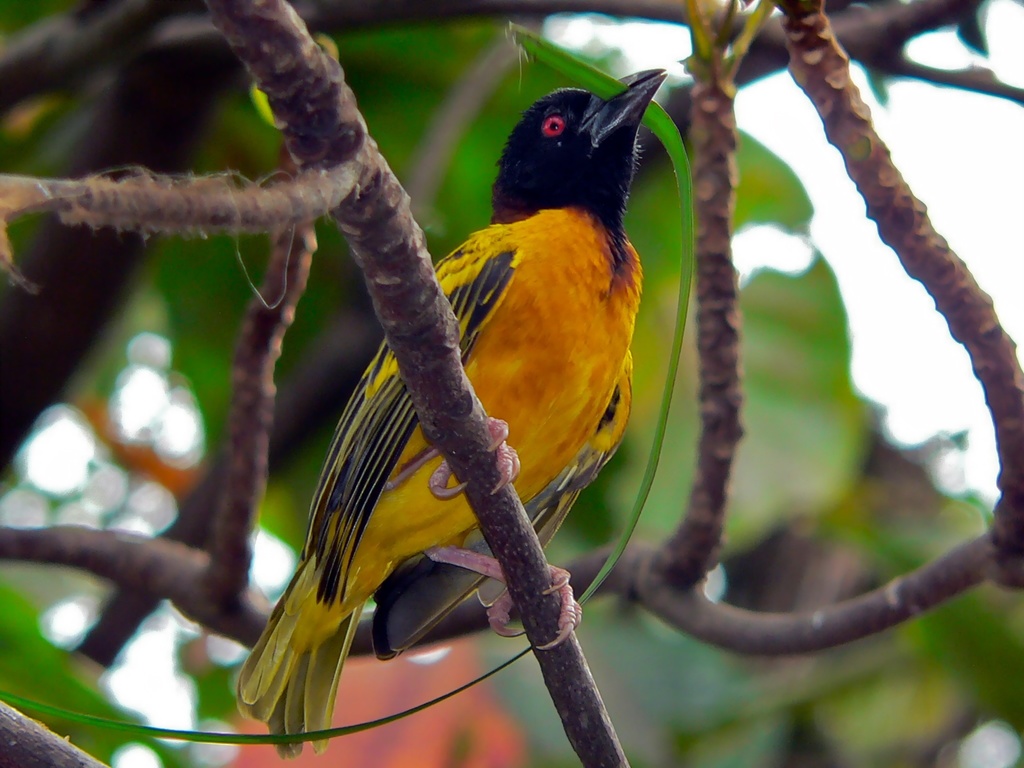
Village Weaver
Ploceus cucullatus
Birdstrong against fish, reptiles
Common
Swoop
While active with another bird in play, it hits 6 harder on its first attack after entering play (12 with two others).
42

37
Village Weaver
Ploceus cucullatus
Birdstrong against fish, reptiles
Common
While active with another bird in play, it hits 6 harder on its first attack after entering play (12 with two others).
Ploceus cucullatus
Photo: © Bernard DUPONT (original photo) · CC BY-SA 4.0 (licence text) · cropped
Strong against: it deals 20% more damage to them. Weak against: these types deal 20% more damage to it.
The village weaver (Ploceus cucullatus), also known as the spotted-backed weaver or black-headed weaver (the latter leading to easy confusion with P. melanocephalus), is a bird species in the family Ploceidae found in much of sub-Saharan Africa. It has also been introduced to Portugal and Venezuela as well as to the islands of Hispaniola, Martinique, Puerto Rico, Mauritius and Réunion.
This often abundant species occurs in a wide range of open or semi-open habitats, including woodlands and human habitation, and frequently forms large noisy colonies in towns, villages, and hotel grounds. This weaver builds a large coarsely woven nest made of grass and leaf strips with a downward-facing entrance, which is suspended from a branch in a tree. Two or three eggs are laid. Village weavers are colonial breeders, so many nests may hang from one tree.
Village weavers feed principally on seeds and grain, and can be a crop pest, but readily take insects, especially when feeding young, which partially redresses the damage to agriculture. The calls of this bird include harsh buzzes and chattering.
Excerpt from the Wikipedia article Village weaver, by its authors, under the CC BY-SA 4.0 licence.
Least Concern on the IUCN Red List: that’s what makes this card Common.
Every Common card has 100 points, shared between HP, ATK and DEF:
How they’re shared out:

 DEF 37