 …
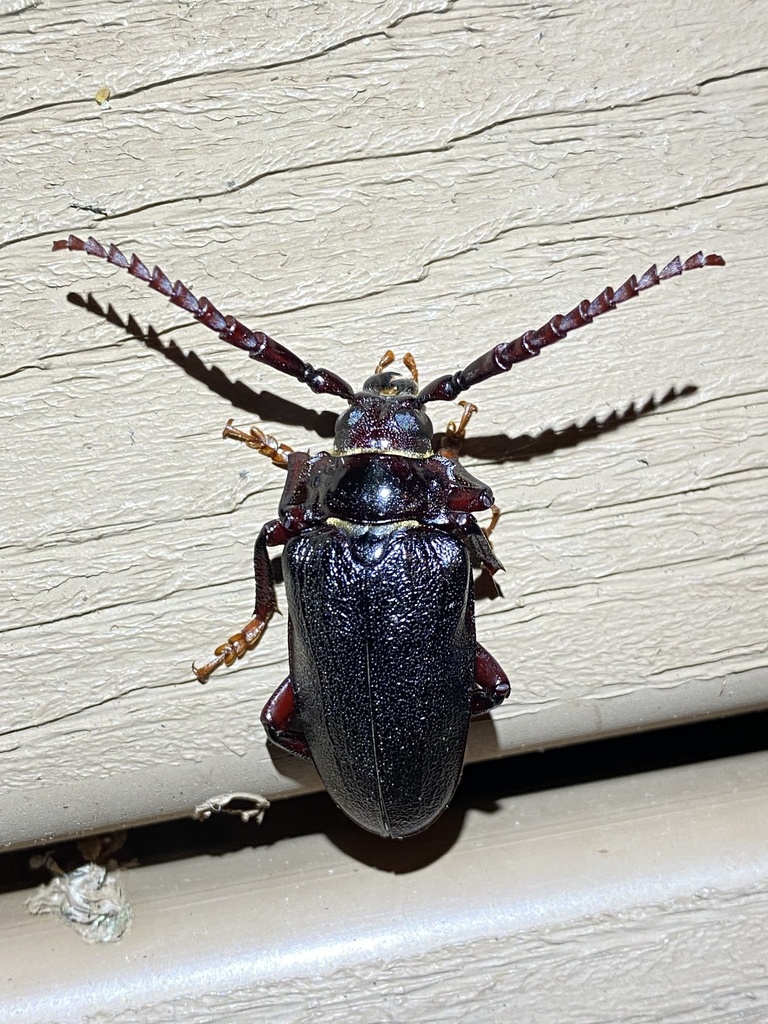
Broad-necked Root Borer
Prionus laticollis
Insectstrong against fungi, fish
Common
Swarm
While active with another insect in play, each of its attacks also hits the opposing bench for 10, without knocking them out (20 with two others).
30

39
Broad-necked Root Borer
Prionus laticollis
Insectstrong against fungi, fish
Common
While active with another insect in play, each of its attacks also hits the opposing bench for 10, without knocking them out (20 with two others).
Prionus laticollis
Photo: Samuel Paul Galick (original photo) · CC0 (licence text) · cropped
Strong against: it deals 20% more damage to them. Weak against: these types deal 20% more damage to it.
Prionus laticollis, also known as the broad-necked root borer or broad necked prionus, is a root-boring longhorn beetle described by Dru Drury in 1773. It is widespread throughout eastern North America: its range covers a vast swath from Quebec in the northeast to Arkansas in the southwest.
The larvae damage trees and other plants by feeding on their roots. They are mostly active during dusk and at night. They are good burrowers and hide at the base of oak trees and other food sources. The female is larger than the male, with an ovipositor used to deposit eggs. When the female is laying eggs, she "shivers" and eggs are laid through the ovipositor, positioned down into the soil or under litter, usually in groups of threes and twos, but sometimes ones or fours. After the eggs are laid, the female moves her ovipositor up and down to fill the hole she created. When freshly laid, the eggs are pure white, glistening with moisture, but, after a while, they usually change to a deep yellow. Within a few days, the deep yellow eggs turn to a light washed pink. As the larvae develop inside, the eggs turn ivory in color. The eggs are the size of small grains of rice. When the larvae are hatching, they chew through one of the elongated, pointed sides of the egg. The larvae's heads are adapted for digging into the soil, and they have strong black mandibles for chewing roots.
Abridged excerpt from the Wikipedia article Prionus laticollis, by its authors, under the CC BY-SA 4.0 licence.
No global status on the IUCN Red List: that’s what makes this card Common.
Every Common card has 100 points, shared between HP, ATK and DEF:
How they’re shared out:

 DEF 39