 …
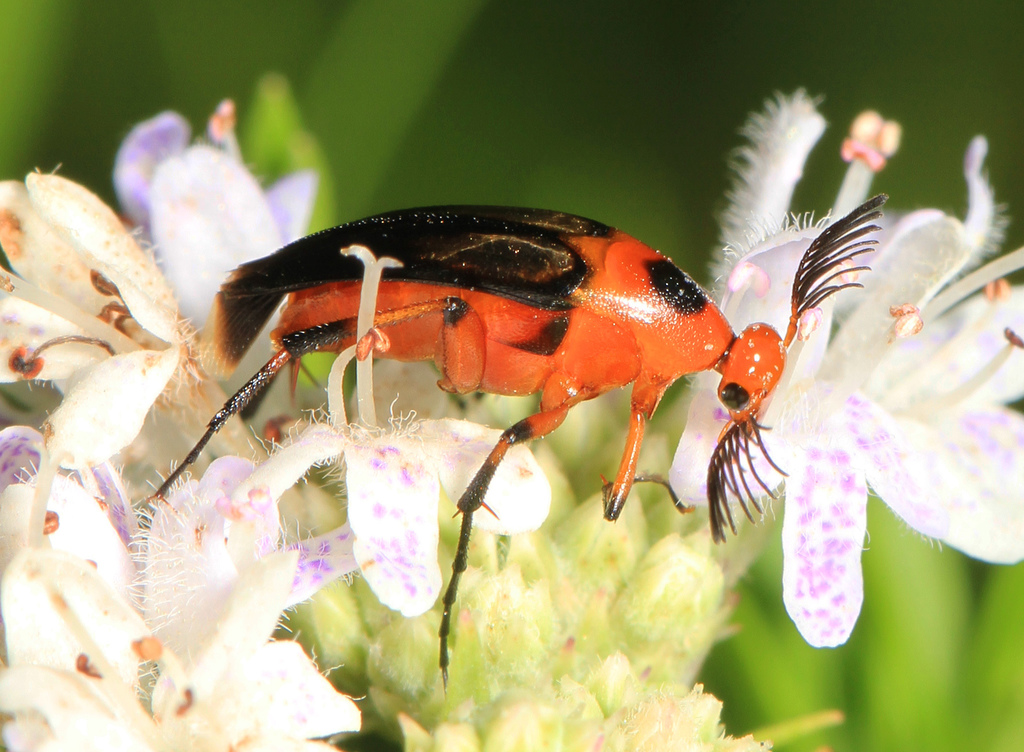
Bordered Wedge-shaped Beetle
Macrosiagon limbata
Insectstrong against fungi, fish
Common
Swarm
While active with another insect in play, each of its attacks also hits the opposing bench for 10, without knocking them out (20 with two others).
39

38
Bordered Wedge-shaped Beetle
Macrosiagon limbata
Insectstrong against fungi, fish
Common
While active with another insect in play, each of its attacks also hits the opposing bench for 10, without knocking them out (20 with two others).
Macrosiagon limbata
Photo: © Judy Gallagher (original photo) · CC BY 4.0 (licence text) · cropped
Strong against: it deals 20% more damage to them. Weak against: these types deal 20% more damage to it.
Macrosiagon limbata is a species of wedge-shaped beetle in the family Ripiphoridae. They are found across the Eastern United States, Southeastern Canada and Central America. It is likely that their range extends into South America but this currently remains unknown.
Macrosiagon limbata was first discovered in 1781 by the famous zoologist Johan Christian Fabricius. Coleopterans in the genus Macrosiagon are internal parasites of other insects at some point during their lifecycle. They go through a form of hypermetamorphosis, in which the larva goes through multiple stages of morphologically distinct instars. The female deposits eggs on flowers visited by bees and other hymenopterans. Larva of Macrosiagon limbata have been reported as parasites of the wasp family Crabronidae. The first larval instar is a planidum, an active larva that can climb on a host hymenopteran. They are then transported to the host's nest, where they act as parasitoids. The following instars don't have legs, and feed on larvae or stored pollen and nectar supplies.
Adult Macrosiagon limbata are active in summer and can be found on flowers such as elderberries and goldenrod. They have prolonged mouthparts thought to be used for sucking nectar. Males have comblike antennae while female antennae are serrate. The elytra are longer than the abdomen and diverge at the apex.
Excerpt from the Wikipedia article Macrosiagon limbata, by its authors, under the CC BY-SA 4.0 licence.
No global status on the IUCN Red List: that’s what makes this card Common.
Every Common card has 100 points, shared between HP, ATK and DEF:
How they’re shared out:

 DEF 38