 …
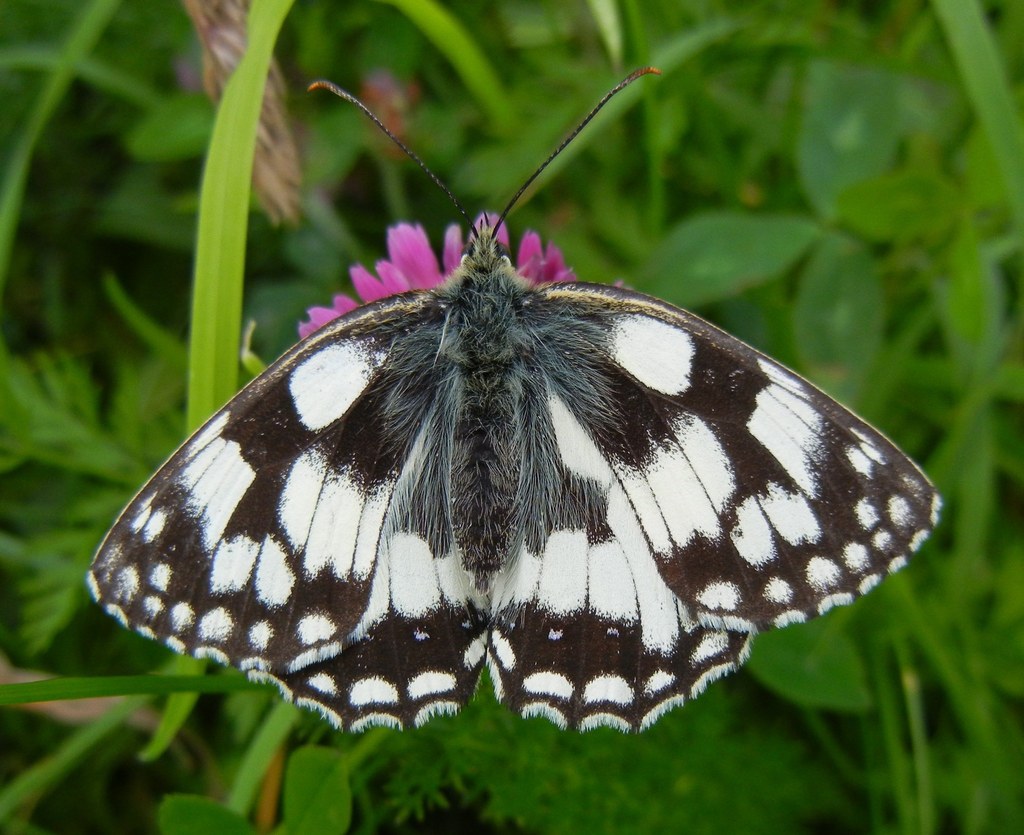
Marbled White
Melanargia galathea
Insectstrong against fungi, fish
Common
Swarm
While active with another insect in play, each of its attacks also hits the opposing bench for 10, without knocking them out (20 with two others).
41

37
Marbled White
Melanargia galathea
Insectstrong against fungi, fish
Common
While active with another insect in play, each of its attacks also hits the opposing bench for 10, without knocking them out (20 with two others).
Melanargia galathea
Photo: © Jon Mortin (original photo) · CC BY 4.0 (licence text) · cropped
Strong against: it deals 20% more damage to them. Weak against: these types deal 20% more damage to it.
Melanargia galathea, the marbled white, is a medium-sized butterfly in the family Nymphalidae. The marbled white was described in 1666 by C Merrett, and in 1695 James Petiver found a specimen in a wood near Hampstead and called it Papilio leucomelanus, our half-Mourner, to distinguish it from the Bath White, which Vernon (1702) had called the half-Mourner. It was also known as The Marmoris by Benjamin Wilkes and The Marmoress by Moses Harris. The butterfly was, also described in 1758, by the Swedish biologist and physician, Carl Linnaeus who formalised binomial nomenclature. Despite its common name and appearance, this butterfly is one of the "browns", of the subfamily Satyrinae.
This species can be found across most of Europe, southern Russia, Asia Minor and Iran. It is found in forest clearings and edges, meadows and steppe where it occurs up to 1,500–1,700 metres (4,900–5,600 ft) above sea level. The caterpillars feed on various grasses.
Excerpt from the Wikipedia article Melanargia galathea, by its authors, under the CC BY-SA 4.0 licence.
No global status on the IUCN Red List: that’s what makes this card Common.
Every Common card has 100 points, shared between HP, ATK and DEF:
How they’re shared out:

 DEF 37