 …
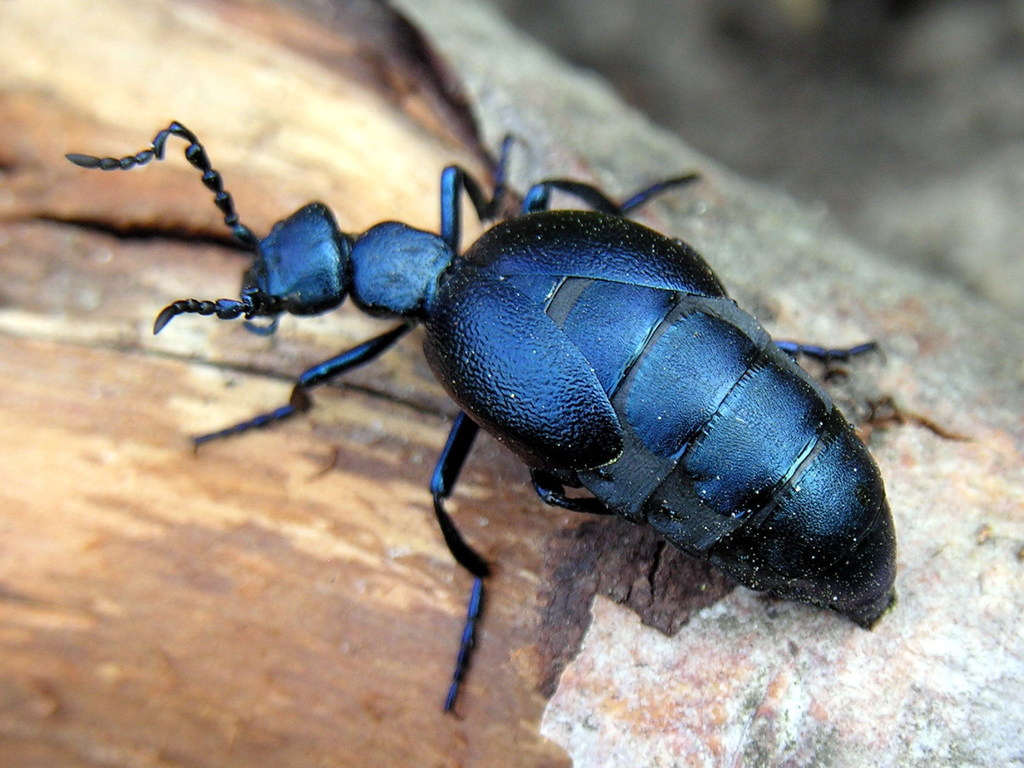
Violet Oil Beetle
Meloe violaceus
Insectstrong against fungi, fish
Common
Swarm
While active with another insect in play, each of its attacks also hits the opposing bench for 10, without knocking them out (20 with two others).
40

38
Violet Oil Beetle
Meloe violaceus
Insectstrong against fungi, fish
Common
While active with another insect in play, each of its attacks also hits the opposing bench for 10, without knocking them out (20 with two others).
Meloe violaceus
Photo: © Algirdas (original photo) · CC BY-SA 4.0 (licence text) · cropped
Strong against: it deals 20% more damage to them. Weak against: these types deal 20% more damage to it.
Meloe violaceus, the violet oil beetle, is a species of oil beetle belonging to the family Meloidae subfamily Meloinae.
This beetle is present in most of Europe, in the eastern Palearctic realm, in the Near East, and in North Africa.
This species is characterised by hypermetamorphosis, a kind of complete insect metamorphosis in which, in addition to the normal stages of larva, nymph and imago, they have several others, with great differences in appearance and way of life.
The body of Meloe violaceus is 10–30 millimetres (0.4–1.2 in) long, females are somewhat larger than the males. These beetle are black-blue or violet-blue, head and pronotum are very finely dotted and the elytra are quite shorter than the abdomen, as in other Meloinae species.
The adults live on a sunny, dry area with flowering plants, feeding on pollen.
In May–June the female digs into the soil 20–30 millimetres (0.8–1.2 in) deep cylindrical holes, where they lay a very large quantity of eggs (about 2,000–10,000).
After about a month larvae emerge from eggs and climb up on grass or on flowers, waiting to cling to the thorax of approaching potential host insects seeking pollen or nectar.
The larvae have an exclusively parasitic life, primarily in the nests of solitary bees, or sometimes of locusts. If the larvae have inadvertently selected a honey bee, they die in the hive and may cause serious damage.
Abridged excerpt from the Wikipedia article Meloe violaceus, by its authors, under the CC BY-SA 4.0 licence.
No global status on the IUCN Red List: that’s what makes this card Common.
Every Common card has 100 points, shared between HP, ATK and DEF:
How they’re shared out:

 DEF 38