 …
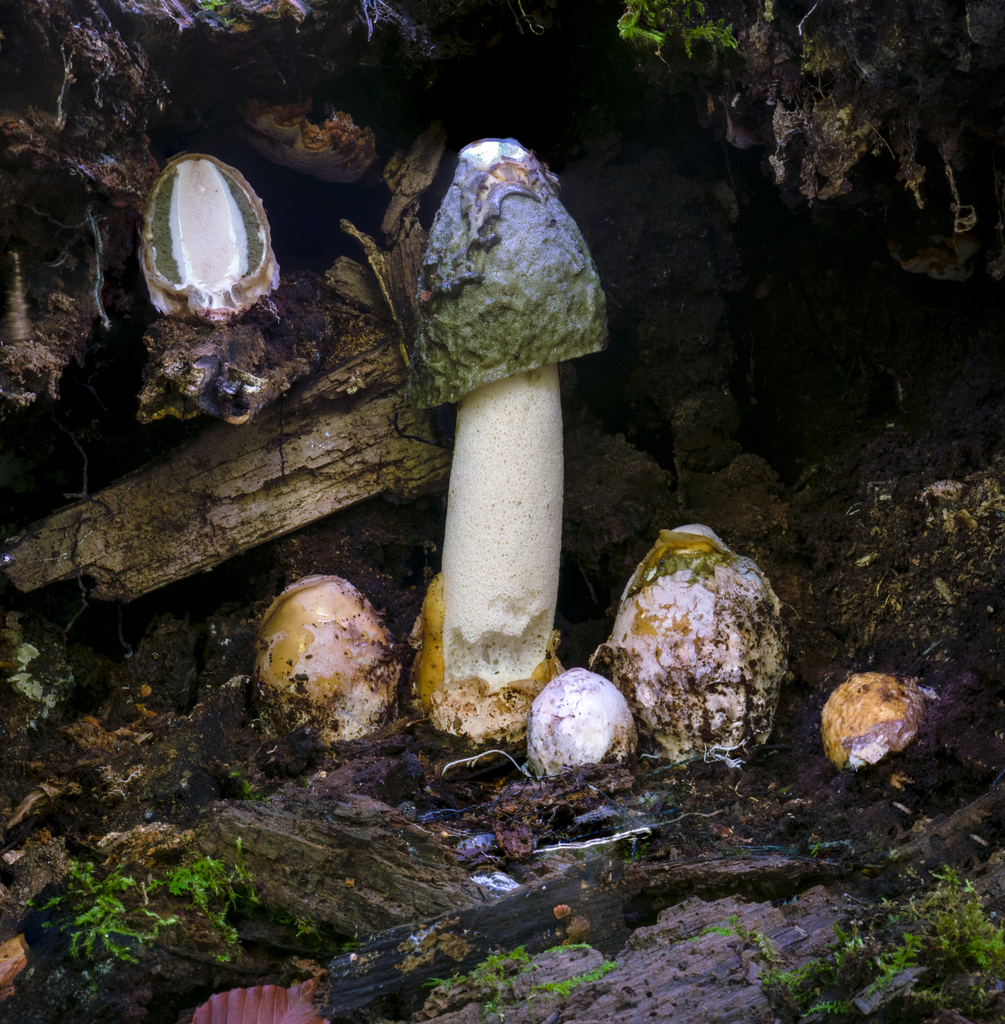
Ravenel's stinkhorn
Phallus ravenelii
Fungusstrong against amphibians, reptiles
Common
Mycelium
While active with another fungus in play, it regains 5 HP at the start of your turn (8 with two others).
43

27
Ravenel's stinkhorn
Phallus ravenelii
Fungusstrong against amphibians, reptiles
Common
While active with another fungus in play, it regains 5 HP at the start of your turn (8 with two others).
Phallus ravenelii
Photo: © Alan Rockefeller (original photo) · CC BY 4.0 (licence text) · cropped
Strong against: it deals 20% more damage to them. Weak against: these types deal 20% more damage to it.
Phallus ravenelii, commonly known as Ravenel's stinkhorn, is a fungus in the Phallaceae (stinkhorn) family. It is found in eastern North America. Its mushrooms commonly grow in large clusters and are noted for their foul odor and phallic shape when mature. It is saprobic, and as such it is encountered in a wide variety of habitats rich in wood debris, from forests to mulched gardens or sawdust piles in urban areas. It appears from August to October. The fruit body emerges from a pink or lavender-colored egg to form a tall, cylindrical, hollow and spongy white stalk with a bell-shaped cap. The remains of the egg persist as a white to pink or lilac volva at the base of the stalk. The cap is covered in a foul-smelling olive-green spore slime, which attracts insects that help to spread the spores. Sometimes, the cap has a "veil" attached—a thin membrane that hangs underneath. The lack of a roughly ridged and pitted cap differentiates it from the closely related Phallus impudicus. The fungus is named after Henry William Ravenel, a botanist who first discovered it in 1846, though it remained undescribed until 1873. It is considered to be an edible mushroom while in its egg form.
Excerpt from the Wikipedia article Phallus ravenelii, by its authors, under the CC BY-SA 4.0 licence.
Least Concern on the IUCN Red List: that’s what makes this card Common.
Every Common card has 100 points, shared between HP, ATK and DEF:
How they’re shared out:

 DEF 27