 …
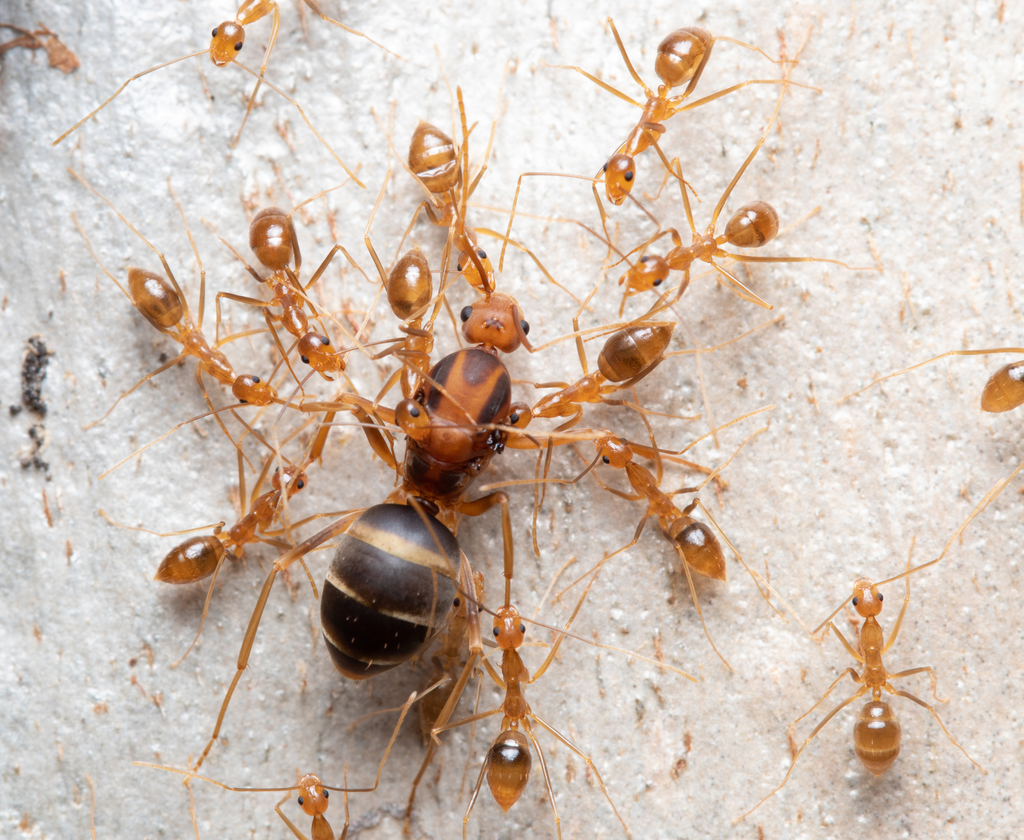
Yellow Crazy Ant
Anoplolepis gracilipes
Insectstrong against fungi, fish
Common
Swarm
While active with another insect in play, each of its attacks also hits the opposing bench for 10, without knocking them out (20 with two others).
30

36
Yellow Crazy Ant
Anoplolepis gracilipes
Insectstrong against fungi, fish
Common
While active with another insect in play, each of its attacks also hits the opposing bench for 10, without knocking them out (20 with two others).
Anoplolepis gracilipes
Photo: © Nigel Main (original photo) · CC BY 4.0 (licence text) · cropped
Strong against: it deals 20% more damage to them. Weak against: these types deal 20% more damage to it.
The yellow crazy ant (Anoplolepis gracilipes), also known as the long-legged ant or Maldive ant, is a species of ant, thought to be native to Asia. They have been accidentally introduced to numerous places in the world's tropics.
The yellow crazy ant has colloquially been given the modifier "crazy" on account of the ant's erratic movements when disturbed. Its long legs and antennae make it one of the largest invasive ant species in the world.
Like several other invasive ants, such as the red imported fire ant (Solenopsis invicta), the big-headed ant (Pheidole megacephala), the little fire ant (Wasmannia auropunctata), and the Argentine ant (Linepithema humile), the yellow crazy ant is a "tramp ant", a species that easily becomes established and dominant in new habitat due to traits such as aggression toward other ant species, little aggression toward members of its own species, efficient recruitment, and large colony size.
It is on a list of "one hundred of the world's worst invasive species" formulated by the International Union for Conservation of Nature (IUCN), having invaded ecosystems from Hawaii to the Seychelles, and formed supercolonies on Christmas Island in the Indian Ocean.
In 2023, a scientific article postulated a unique reproductive cycle for A. gracilipes, suggesting that males are obligate chimeras.
Excerpt from the Wikipedia article Yellow crazy ant, by its authors, under the CC BY-SA 4.0 licence.
No global status on the IUCN Red List: that’s what makes this card Common.
Every Common card has 100 points, shared between HP, ATK and DEF:
How they’re shared out:

 DEF 36